Something quietly historic happened in Australian maternity care this year. From 1 June 2026, every pregnant woman in South Australia is offered an omega-3 blood test as part of her routine antenatal care — the first place in the world to do it. It's a collaboration between SAHMRI and SA Pathology, and it's the culmination of roughly two decades of research.
Why test for omega-3 in pregnancy at all?
The logic is refreshingly simple. Women who begin pregnancy with a low omega-3 level have a higher risk of giving birth early, and topping up omega-3 in those who are low reduces that risk. Rather than telling every pregnant woman to take fish oil — or none of them — the program tests first and treats only the women who actually need it.
That distinction matters more than it sounds. As the ORIP trial showed, blanket supplementation doesn't help everyone; the benefit is concentrated in women who start out low. Testing is what tells you which group you're in.
What the research found
Across the work that led to the program, around 37,000 women were tested, and roughly 17% had a low omega-3 level — about one in six. Women who test low are advised to take a daily dose of around 800 mg DHA and 100 mg EPA through the rest of pregnancy. The published evaluation in the Medical Journal of Australia goes into the detail.
It's worth being honest about scope: this is about reducing the risk of early birth in women who are deficient. It isn't a promise, and omega-3 is one factor among many. But as a low-cost, low-risk step with a real evidence base behind it, it's a genuinely sensible piece of preventive care.
The catch: it's only South Australia, and only pregnancy
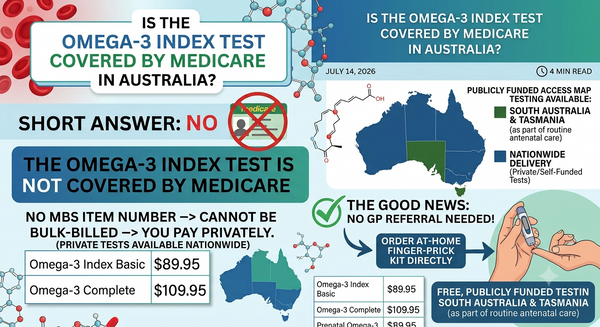
The free test is funded through SA Pathology for pregnant women in South Australia. If you're pregnant elsewhere in Australia — or you're not pregnant at all — it isn't part of your standard care, and it isn't covered by Medicare. There's no national rollout, at least not yet.
That leaves a lot of people who now know omega-3 status is worth checking, but have no obvious way to check it.
How to check your own level
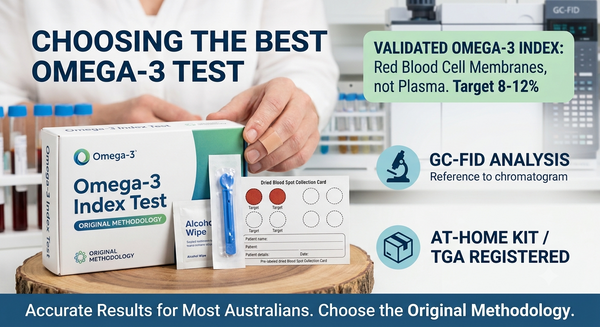
You don't need to be in a research program to find out where you stand. Our at-home Omega-3 Index test uses a simple finger-prick sample, posted back to our accredited Melbourne laboratory and analysed by GC-FID — the same method used in the research above — with results in 3–5 days. If you'd like to understand what the numbers mean first, here's how to read your result, and here's what separates an accurate test from a rough one.
An evidence-honest note: testing is most valuable if you're pregnant or planning a pregnancy, or if you have a family or personal reason to care about your omega-3 status. If you already eat oily fish a few times a week, you may well be fine — but the only way to know is to measure, rather than assume.
The bottom line
South Australia has done something the rest of the world hasn't: made omega-3 status a routine, measured part of pregnancy care rather than guesswork. For everyone outside that program, the takeaway is the same — your level is knowable, and knowing it beats guessing.
Know your number.
A simple at-home finger-prick test, posted to your door. Find out where you actually stand on omega-3.
See our tests