Search "omega-3 test" and you'll find everything from finger-prick kits to practitioner panels, at prices from under $50 to over $110. They're not all measuring the same thing to the same standard. Rather than tell you which brand to buy, here's what actually makes an omega-3 test trustworthy — so you can judge any of them.
5 things that make an omega-3 test "the best"
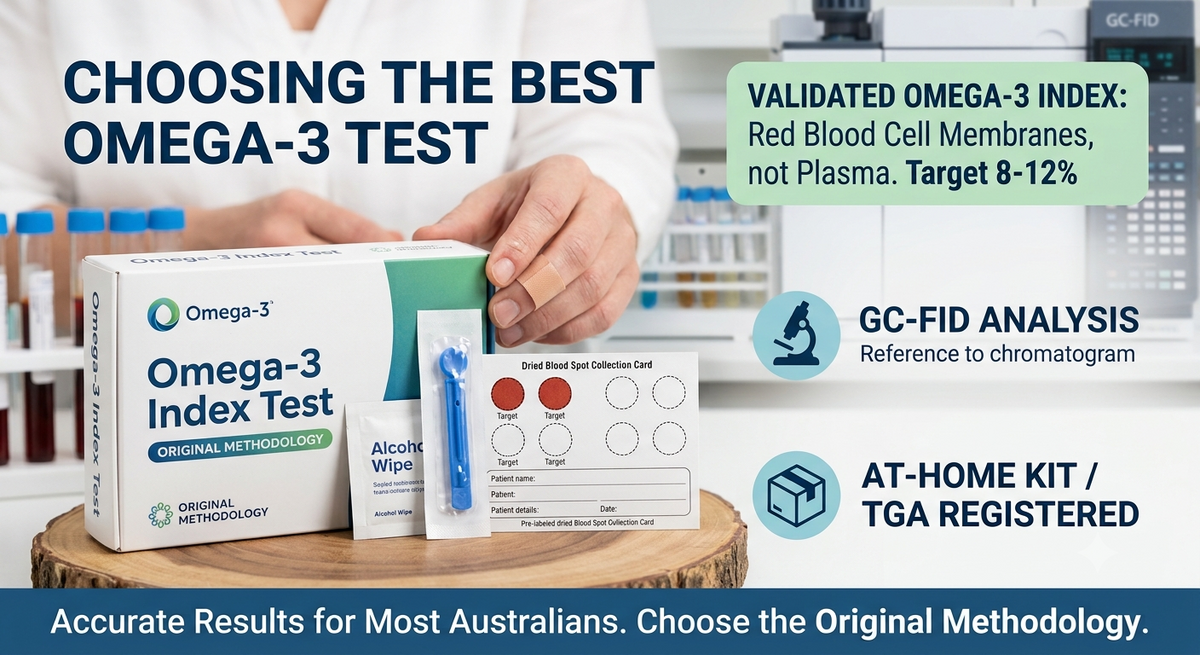
- It measures the Omega-3 Index (red blood cells), not just plasma. The Omega-3 Index reflects EPA + DHA in your red blood cell membranes, which turn over slowly — so it shows your status over the last 3–4 months, not just what you ate yesterday. Plasma or serum snapshots are far noisier.
- It uses the original, validated methodology. "Omega-3 Index" is a specific method defined by Harris & von Schacky (2004) with a published reference scale (optimal 8–12%) built from 450+ studies. A result on that recognised scale means something; a similar-sounding number generated a different way may not.
- It's analysed by GC-FID. Gas chromatography with flame ionisation detection is the reference method for fatty acid analysis — it separates and quantifies each fatty acid individually. If a test doesn't state GC-FID, be cautious.
- It's run by an accredited Australian lab with quality control. Accreditation, internal standards and QC checks (with out-of-range results reviewed by a scientist) are what make a number reliable. Australian analysis also means no long international transit for your sample.
- The kit is regulated, and turnaround and pricing are transparent. Look for a TGA-registered collection kit, a clear turnaround time, and an all-in price with no hidden consultation fee.
Basic Index, ratios, or the full profile?
Once the method is sound, the "best" test simply depends on how much detail you want:
| If you want to... | Choose |
|---|---|
| Know your core omega-3 number | Omega-3 Index Basic — EPA + DHA on the 8–12% scale |
| Understand your inflammatory balance | Plus Ratios — adds omega-6:3 and AA:EPA ratios |
| See your complete fatty-acid picture | Complete — the full 24 fatty acids |
| Monitor omega-3 in pregnancy | Prenatal Omega-3 — DHA on a pregnancy-tuned scale |
Not sure? Our 30-second quiz matches you to one.
At-home kit vs a test through your GP
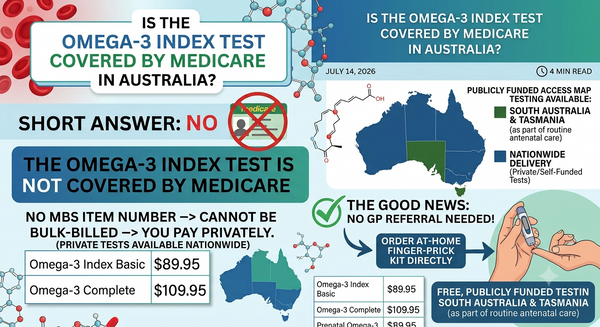
The Omega-3 Index isn't part of routine GP pathology in Australia, and it isn't covered by Medicare — so most people use a direct-to-consumer test. A good at-home finger-prick (dried blood spot) test is well validated: it shows R² > 0.96 correlation with the gold-standard red blood cell method when both are analysed by GC-FID. You don't need a referral, and you collect the sample yourself in two minutes. (More on this in our honest answer on at-home test accuracy.)
What does the best omega-3 test cost?
In Australia, expect roughly $50–$120 depending on the panel and provider. A basic Omega-3 Index usually sits under $100; a full fatty-acid profile costs more because it measures far more analytes. Ours run from $89.95 (Index Basic) to $109.95 (Complete), with free shipping both ways and results in 3–5 days.
Test with the original Omega-3 Index — from the Australian lab
At-home finger-prick, GC-FID analysis, results in 3–5 days. Free shipping both ways, no referral needed.
See our tests — from $89.95 →Common questions
Which omega-3 test is best in Australia?
The best omega-3 test is one that measures your Omega-3 Index (EPA + DHA in red blood cells) using the validated original methodology, analysed by GC-FID at an accredited Australian lab. Choose the basic Index for a core check, or a fuller panel (ratios or the 24-fatty-acid profile) if you want more detail.
What is the best Omega-3 Index level to aim for?
Published research links an Omega-3 Index of 8–12% to better long-term outcomes. Most Australians sit around 4–6%.
Is a home omega-3 test accurate?
Yes, when the dried blood spot sample is analysed by GC-FID at an accredited lab — it correlates with the gold-standard red blood cell method at R² > 0.96. The finger-prick is only the collection step; the analysis still happens in a laboratory.
How much does the best omega-3 test cost?
Typically from about $89.95 for a basic Omega-3 Index up to around $109.95 for a full 24-fatty-acid profile, depending on the provider and panel.
References
- Harris WS, von Schacky C. The Omega-3 Index: a new risk factor for death from coronary heart disease? Preventive Medicine. 2004;39(1):212–220.
- Stark KD, et al. Global survey of the omega-3 fatty acids in healthy adults. Progress in Lipid Research. 2016;63:132–152.
- Walker RE, et al. Predicting the effects of supplemental EPA and DHA on the omega-3 index. American Journal of Clinical Nutrition. 2019;110(4):1034–1040.
This article is general information, not medical advice, and does not diagnose, treat or prevent any condition. Discuss testing or supplement decisions with your GP.
Know your number.
A simple at-home finger-prick test, posted to your door. Find out where you actually stand on omega-3.
See our tests