If you've ever taken an omega-3 supplement (fish oil, algae, krill, or plant sources) and wondered "is this actually doing anything?", the Omega-3 Index is the answer. It's a single number that tells you whether your body has enough EPA and DHA — the two long-chain omega-3 fatty acids most consistently linked to better health outcomes in published research.
What it actually measures
The Omega-3 Index is the percentage of EPA + DHA in your red blood cell membranes. It was first proposed by Harris and von Schacky in 2004 as a more biologically meaningful measure of omega-3 status than serum or plasma levels.
The reason it's measured in red blood cells (rather than just blood plasma) is turnover speed. Plasma levels reflect what you ate yesterday. Red blood cell membranes turn over slowly — over roughly 3 to 4 months — so the Index reflects your actual long-term omega-3 status, not the salmon you had on Tuesday.
The reference scale
Three categories, broadly aligned across published research:
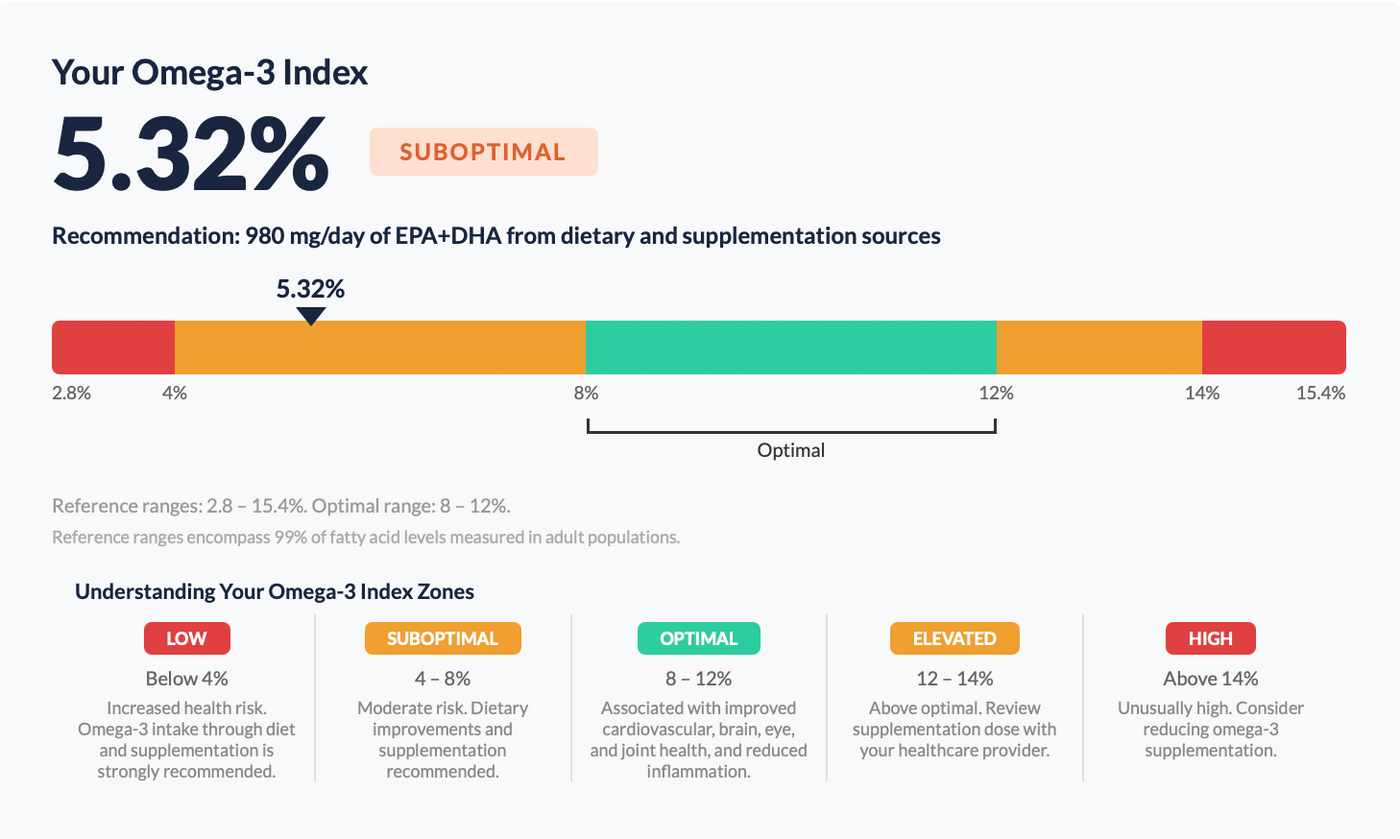
- Low: less than 4% — associated with the highest cardiovascular risk in observational studies
- Suboptimal: 4 to 8% — the band most Western populations sit in
- Optimal: 8 to 12% — the level Harris and colleagues originally proposed as the target for cardioprotection
The reference range in our own reports runs from 2.8% to 15.4% — the bounds that encompass roughly 99% of fatty acid levels measured across adult populations.
Why it's a better marker than "do you take a supplement?"
Two reasons. First, omega-3 supplements vary enormously in EPA + DHA content, in absorption, and in how well your body actually incorporates them. Whether you take fish oil, krill oil, or algae-based omega-3, two people on "the same" supplement at the same dose can end up with very different levels.
Second, intake from food is just as variable. A serve of Atlantic salmon delivers ~1,500 mg of EPA + DHA. A serve of canned tuna delivers ~250 mg. Australian fish consumption averages a few times per week at most — and conversion from plant-based ALA (in flax, chia, walnuts) to EPA and especially DHA is famously inefficient (less than 5% in most adults).
Where Australians actually sit
The 2016 global survey of omega-3 status by Stark and colleagues placed Australia in the 'low' band — well below the 8–12% optimal range. We sit alongside most Western, low-seafood-consumption populations. Countries with traditionally high seafood diets (Japan, Korea, parts of Scandinavia) sit much higher.
For most Australians, this means the question isn't "should I supplement" — it's "by how much, and is what I'm doing actually working?"
How to improve your number, if it's low
Three levers, in order of how reliably they move the needle:
- Higher-dose EPA + DHA from supplements (fish oil for most, algae-based for vegans/vegetarians). 1,000–2,000 mg per day is what most clinical trials use. The combined EPA + DHA matters more than the brand or source.
- More oily fish. Two to three serves per week of salmon, sardines, mackerel, anchovies, or trout will move levels meaningfully. White fish (tuna, snapper, barramundi) is much lower in EPA + DHA.
- Time. RBC membranes take 8–12 weeks to fully reflect supplement changes — don't retest sooner than that.
Whatever you change, you won't know if it worked without retesting. That's the whole reason the Index exists.
Find out where you actually stand
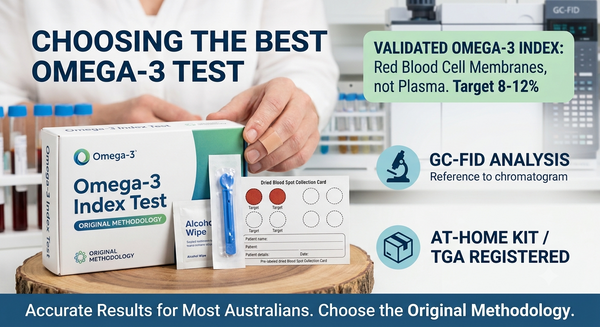
Our Omega-3 Index Basic test measures EPA + DHA from a single finger-prick. Posted to your door, results in 3–5 days.
Order — $89.95 →References
- Harris WS, von Schacky C. The Omega-3 Index: a new risk factor for death from coronary heart disease? Preventive Medicine. 2004;39(1):212-220.
- Stark KD, Van Elswyk ME, Higgins MR, Weatherford CA, Salem N. Global survey of the omega-3 fatty acids in healthy adults. Progress in Lipid Research. 2016;63:132-152.
- GOED Clinical Study Database — the largest curated collection of human omega-3 research, with over 4,600 interventional studies extracted from a 45,000+ paper scoping review.
Know your number.
A simple at-home finger-prick test, posted to your door. Find out where you actually stand on omega-3.
See our tests