"How much omega-3 should I take?" is one of those questions where the answer most websites give — usually some version of "250–500 mg a day" — is technically correct and practically useless. The actual amount you need depends on what you eat, what your starting level is, and what you want to achieve.
This guide walks through the official Australian recommendations, what the research actually shows, and how to figure out the dose that's right for you.
The short answer (and why it's not enough)
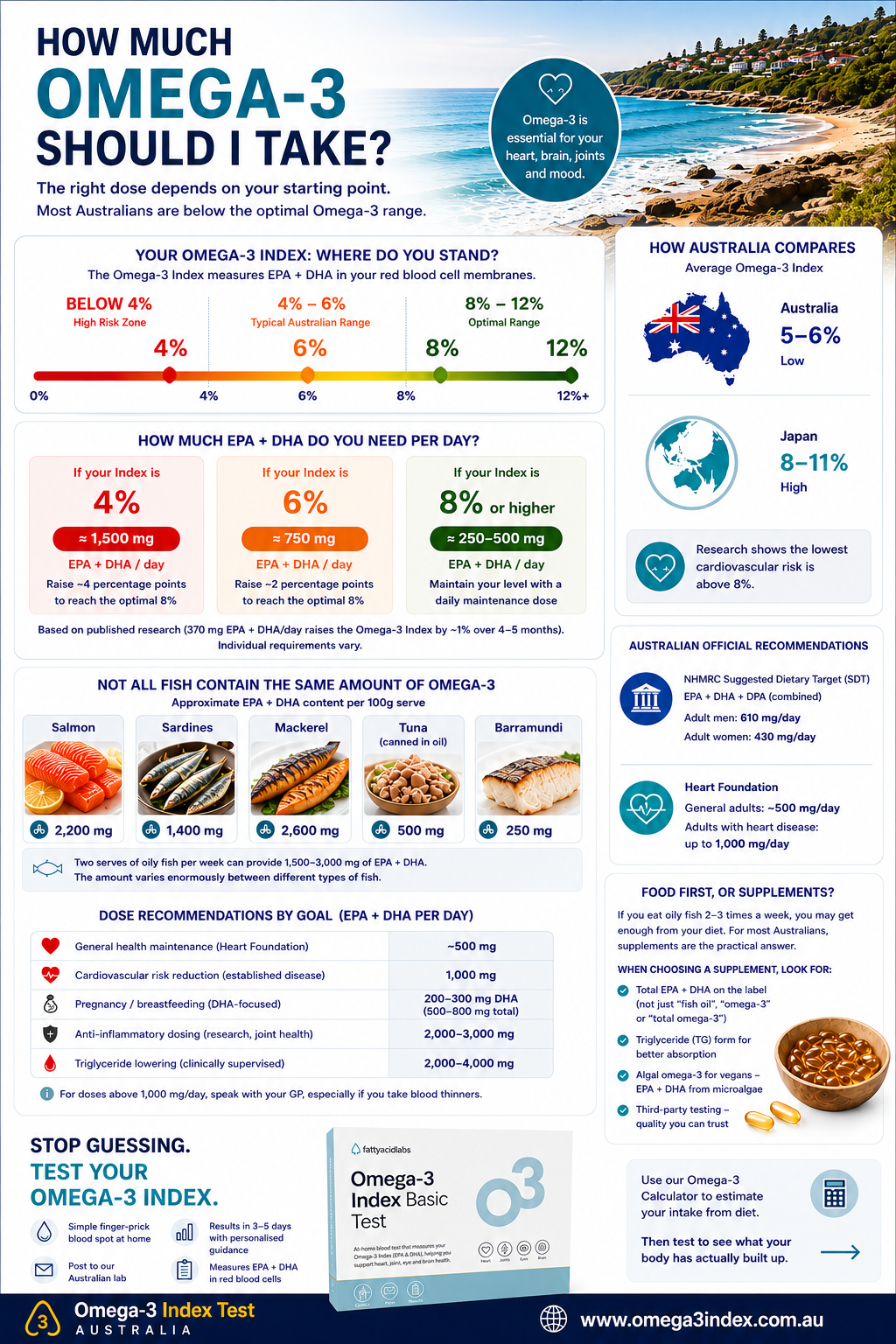
For general health maintenance, the Heart Foundation and the National Health and Medical Research Council (NHMRC) recommend Australian adults aim for around 500 mg of combined EPA + DHA per day — the two long-chain omega-3 fatty acids found in oily fish.
That's a fine starting point. But it's an average population recommendation, designed to reduce the risk of cardiovascular disease across a national population. It doesn't tell you whether you, specifically, are getting enough — and it almost certainly underestimates what people with low baseline levels actually need.
The more useful frame: omega-3 needs depend on three things.
- What you're starting from. Someone whose Omega-3 Index is 3% needs much more than someone at 6%.
- What you eat. Two serves of oily fish per week provides 1,500–3,000 mg of EPA + DHA on its own.
- What target you're aiming for. 8% Omega-3 Index — the level associated with the lowest cardiovascular risk in research — requires a different dose for different people.
Australian official guidelines
Australia's main official intake recommendation is from the NHMRC's Nutrient Reference Values, published jointly with New Zealand. The relevant numbers for long-chain omega-3 (EPA + DHA + DPA, combined):
| Group | Adequate Intake (AI) | Suggested Dietary Target (SDT) |
|---|---|---|
| Adult men | 160 mg/day | 610 mg/day |
| Adult women | 90 mg/day | 430 mg/day |
| Pregnant women | 115 mg/day | — |
| Breastfeeding women | 145 mg/day | — |
| Children 9–13 | 55–70 mg/day | — |
The Adequate Intake (AI) represents the minimum needed to avoid deficiency. The Suggested Dietary Target (SDT) represents the amount associated with reduced chronic disease risk — closer to what most clinicians actually recommend.
The Heart Foundation Australia position statement goes further, recommending around 500 mg of EPA + DHA per day for general adults and up to 1,000 mg/day for adults with established heart disease.
How much omega-3 is actually in food?
Long-chain omega-3 fatty acids (EPA and DHA) come almost exclusively from marine sources. Plant foods like flaxseed and chia contain ALA, a short-chain omega-3 that the body converts into EPA and DHA — but very inefficiently (typically less than 5%).
Approximate EPA + DHA content per 100g serve of common fish:
- Atlantic salmon — 2,200 mg
- Sardines — 1,400 mg
- Mackerel — 2,600 mg
- Trout — 1,000 mg
- Tuna (canned in oil) — 500 mg
- Snapper — 300 mg
- Barramundi — 250 mg
- Prawns — 250 mg
The variation is enormous. Two serves of Atlantic salmon per week (around 300g total) delivers roughly 6,600 mg of EPA + DHA across the week — about 940 mg/day on average. Two serves of barramundi delivers less than 110 mg/day.
If you'd like to figure out your daily intake from your typical diet, our Omega-3 Calculator does the maths for you.
What the research actually shows
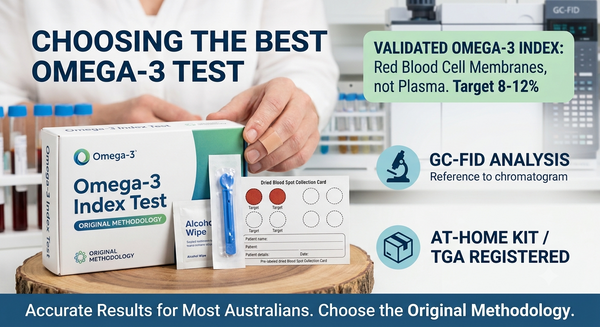
Most research on omega-3 doesn't measure intake — it measures the Omega-3 Index, the percentage of EPA + DHA in your red blood cell membranes. This matters because it bypasses all the variables in absorption and metabolism.
The landmark dose-response study by Walker and colleagues (2019) found that raising your Omega-3 Index by 1% requires roughly 370 mg of EPA + DHA per day for about 4–5 months — though this varies significantly by individual.
So if your Omega-3 Index is 4% (suboptimal) and you want to reach 8% (optimal):
- You need to raise it 4 percentage points
- That requires roughly 4 × 370 = 1,480 mg of EPA + DHA per day
- Sustained for at least 4–5 months
For someone starting at 6% (most Australians' approximate range), reaching 8% requires only around 740 mg/day. For someone at 2% (rare but possible), reaching 8% would require closer to 2,200 mg/day.
This is why generic recommendations break down. The "right" dose for you depends entirely on where you're starting from — and there's no way to know without measuring.
The Australian baseline problem
Stark and colleagues (2016) published a global survey of Omega-3 Index values across 22 countries. Australia and New Zealand sat in the low-to-very-low range, with average values around 5–6%. For context:
- Japan, South Korea: average 8–11% (high)
- Scandinavia: 6–8% (moderate)
- Australia, New Zealand, UK, USA: 4–6% (low)
The cardiovascular research consistently shows the lowest disease risk above 8%, and the highest risk below 4%. Most Australians sit between those thresholds — closer to the bad end than the good end — and don't know it.
This is why we built the calculator and the test together: the calculator estimates your dietary intake, but the test tells you what your body has actually built into its cells. They answer different but complementary questions.
Dose recommendations by goal
If you'd rather skip the personalisation and just have a number, here are reasonable starting points based on published research:
| Goal | Daily EPA + DHA |
|---|---|
| General population maintenance (Heart Foundation AU) | ~500 mg |
| Cardiovascular risk reduction (established disease) | 1,000 mg |
| Pregnancy / breastfeeding (DHA-focused) | 200–300 mg DHA included in 500–800 mg total |
| Anti-inflammatory dosing (research, joint health) | 2,000–3,000 mg |
| Triglyceride lowering (clinically supervised) | 2,000–4,000 mg |
For doses above 1,000 mg/day, it's worth discussing with a GP — particularly if you're on blood thinners.
Food first, or supplements?
If you eat oily fish two or three times a week, you can hit reasonable omega-3 targets through diet alone. For most Australians who don't eat much fish, supplements are the practical answer.
When choosing a supplement, look for:
- Total EPA + DHA on the label — not just "fish oil 1,000 mg" which usually contains only ~300 mg of actual EPA + DHA
- Form — triglyceride (TG) form is best absorbed; ethyl ester (EE) form is cheaper but less efficient
- Algal omega-3 for vegans — sourced from microalgae, contains EPA + DHA directly (skipping the inefficient ALA conversion)
- Third-party testing — quality varies enormously in the supplement industry
FAQ
How much omega-3 do I need per day?
For general health, the Heart Foundation Australia recommends around 500 mg of combined EPA + DHA per day. People with low Omega-3 Index levels may need 1,000–2,000 mg per day to reach the optimal range of 8%+ within a few months. Pregnant women should aim for at least 200 mg DHA per day.
Can I get enough omega-3 from plant sources?
Plant sources contain ALA, which the body converts to EPA and DHA inefficiently (typically less than 5%). For people who don't eat fish, algal omega-3 supplements provide EPA and DHA directly and are a reliable alternative.
Is 1,000 mg of fish oil per day enough?
A standard 1,000 mg fish oil capsule typically contains around 300 mg of actual EPA + DHA — the rest is filler oils. For a 500 mg EPA + DHA target, you'd need two capsules. Always check the label for actual EPA + DHA content.
How long does it take for omega-3 to raise my Omega-3 Index?
Research suggests that 370 mg of EPA + DHA per day raises the Omega-3 Index by about 1 percentage point over 4–5 months. To raise it faster, higher doses are needed. The Index then stabilises once your daily intake matches your daily turnover.
Can you take too much omega-3?
Doses up to 3,000 mg per day are considered safe for most adults. Above this, the main risks are mild blood thinning effects (relevant for people on anticoagulants) and gastrointestinal discomfort. Always talk to your GP before exceeding 2,000 mg/day.
The honest answer
"How much omega-3 do you need?" has no single right answer. The Heart Foundation's 500 mg/day is a reasonable starting point for general health. If you have any specific goal — pregnancy, cardiovascular risk, anti-inflammatory effect, reaching the 8% Omega-3 Index threshold — the right dose is higher and depends on where you're starting from.
The fastest way to stop guessing is to measure. Our Omega-3 Calculator estimates your intake from your diet. Our at-home Omega-3 Index test tells you what your body has actually built up. Together, they replace generic advice with personalised numbers.
Know your number.
A simple at-home finger-prick test, posted to your door. Find out where you actually stand on omega-3.
See our tests