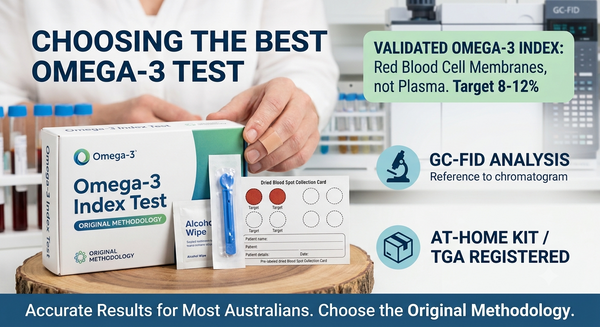
The heart is where omega-3 research began, and it's still the most studied area by a wide margin. But the headlines swing from "fish oil saves lives" to "fish oil does nothing" — so here's a fair, plain-English read of what EPA and DHA actually do for cardiovascular health, what Australian guidelines say, and where your own number fits in.
Why the heart is the most-studied area
The very first use of the Omega-3 Index — defined by Harris and von Schacky in 2004 — was as a marker of cardiovascular risk. They proposed an Index of 8% or above as a target associated with a lower risk of death from coronary heart disease, drawn from the observation that populations with high seafood intake tend to have both high omega-3 levels and low cardiac mortality.
Decades of research have followed. The clearest, most consistent finding is on triglycerides: EPA and DHA are associated with healthier triglyceride levels, which is one reason oily fish features in cardiovascular dietary advice worldwide. Omega-3s are also studied in relation to resting heart rate, blood pressure and the stability of the heart's rhythm — though the strength of evidence varies across each.
What the large trials actually show
This is where it gets nuanced, and where honesty matters. Big randomised trials of omega-3 supplements have produced mixed results. Some — like the high-dose EPA trial REDUCE-IT — reported cardiovascular benefit; others, like VITAL and ASCEND using lower doses, found little effect on their primary endpoints in generally well-nourished populations.
That's exactly why a status marker is more useful than a yes/no "do you take fish oil." It tells you whether you're in the group with room to move, rather than topping up a tank that's already full.
What Australian guidance says
The Heart Foundation recommends including oily fish — salmon, sardines, mackerel, trout — as part of a heart-healthy eating pattern, and the NHMRC sets suggested dietary targets for long-chain omega-3s (EPA, DPA and DHA) for adults. Most Australians fall short of these targets, which is consistent with the national Omega-3 Index sitting in the low band.
Which fish, and how much
Not all seafood is equal. The oily, cold-water species carry far more EPA + DHA than white fish:
- High: salmon, sardines, mackerel, herring, trout, anchovies — roughly 1,000–1,500 mg EPA + DHA per serve
- Lower: canned tuna, snapper, barramundi, basa — useful protein, but far less omega-3
- Supplements: fish oil for most people, or algae-based oil for vegetarians and vegans — what matters is the combined EPA + DHA dose, not the brand
Two to three serves of oily fish a week, or a matched supplement, is what tends to move levels meaningfully. For dose specifics, see how much omega-3 you need daily.
Where your Omega-3 Index fits
Cardiovascular health is multifactorial — blood pressure, cholesterol, glucose, smoking, activity and genetics all matter, and omega-3 status is one modifiable piece. What the Index gives you is a clear, trackable number for that one piece: are you in the low band where research suggests the most to gain, or already optimal?
It's also a number your GP can't get from a standard panel — routine Australian blood tests measure cholesterol and triglycerides, but not EPA + DHA as a percentage of your red blood cells. For background, see what the Omega-3 Index is and how to read your result.
What to do with this
- Test first. Know your starting Index rather than guessing.
- If you're low, raise EPA + DHA through more oily fish or a supplement at a dose matched to your level.
- Retest after 8–12 weeks to confirm it actually worked — red blood cell levels take that long to stabilise.
- Discuss significant results with your GP, especially if you have an existing heart condition or take medication.
Know your number
The Omega-3 Index Basic measures your EPA + DHA from one finger-prick. Posted to your door, results in 3–5 days.
Order — $89.95 →References
- Harris WS, von Schacky C. The Omega-3 Index: a new risk factor for death from coronary heart disease? Preventive Medicine. 2004;39(1):212-220.
- Bhatt DL et al. (REDUCE-IT). Cardiovascular risk reduction with icosapent ethyl. New England Journal of Medicine. 2019;380:11-22.
- Manson JE et al. (VITAL). Marine n-3 fatty acids and prevention of cardiovascular disease. NEJM. 2019;380:23-32.
- Heart Foundation (Australia). Fish, seafood and heart health. NHMRC Nutrient Reference Values for Australia and New Zealand.
This article is general information, not medical advice, and does not diagnose, treat or prevent any condition. Discuss significant results or any heart concerns with your GP.
Know your number.
A simple at-home finger-prick test, posted to your door. Find out where you actually stand on omega-3.
See our tests