The Medical Journal of Australia has published the first peer-reviewed evaluation of an omega-3 "test-and-treat" program for pregnant women in Australia. The findings are striking: nearly 15% of women tested had low omega-3 levels, the program is now being used in around 60% of South Australian antenatal screens, and the authors conclude that blood testing is the gold standard for assessing omega-3 status.
This matters because it's the first time Australian health researchers have shown — at population scale, in a real clinical setting — that you can identify pregnant women at higher risk of preterm birth through a simple blood test, treat them with omega-3, and integrate the whole approach into routine care.
What the paper found
Best and colleagues, writing in the Medical Journal of Australia (Vol 223, Issue 11, November 2025), evaluated the early implementation phase of South Australia's Omega-3 Test-and-Treat Program. Between April 2021 and June 2022, 4,801 omega-3 tests were requested through the state's existing antenatal screening service.
The results, in three numbers:
- 14.7% of women had low omega-3 levels and were advised to supplement
- 34.2% had moderate levels
- 51.1% were sufficient
That means roughly half of pregnant Australian women tested had levels either low or moderate enough that targeted supplementation was clinically warranted. Importantly, the authors found that women in the low group were more likely to be smokers and of non-Caucasian background — meaning the test identifies people who otherwise might not be flagged by clinical judgement alone.
Why preterm birth matters here
Preterm birth — defined as birth before 37 weeks — is the leading cause of newborn death and long-term disability worldwide. Early preterm birth, before 34 weeks, carries the greatest risk.
A 2018 Cochrane systematic review of randomised trials, cited in the new MJA paper, found that omega-3 supplementation during pregnancy reduced early preterm birth by 42% and reduced overall preterm birth by 11%. For a single, low-cost nutritional intervention, that's a large effect.
The challenge until now has been targeting: omega-3 supplementation benefits women with low baseline levels far more than women already sufficient. Without a test, supplementation has been blanket or guesswork. The MJA paper shows that a test-and-treat approach — test everyone, supplement the ones with low levels — is both feasible and well-accepted in Australian antenatal care.
The "gold standard" framing
One of the most quotable lines from the paper is the authors' summary of why blood testing matters at all:
"Blood testing is the gold standard for assessing omega-3 status."
— Best et al., MJA 2025
This matters because there's a lot of marketing in the omega-3 supplement space that estimates "intake" from dietary surveys or guesses dose from body weight. None of those approaches survives contact with measured blood levels. Two women eating the same diet can have very different omega-3 levels — absorption, metabolism, weight, and individual variation all play a role. The only way to know is to measure.
How quickly did the program scale?
In April 2021 — the first month — just 15 tests were ordered, representing 2.4% of the state's antenatal referrals. By June 2022, that had grown to 340 tests per month (29.4% of referrals). At the time of publication, the program is processing more than 800 tests per month, with test requests included in about 60% of all South Australian antenatal screening referrals.
That trajectory matters because it shows what real adoption looks like once clinicians have a test that's fast, accessible, and built into the existing system. 97.6% of samples were reported within 72 hours.
How this works in practice (and how it differs from at-home testing)
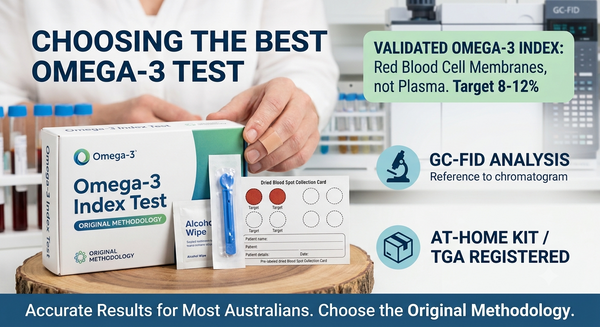
The SAHMRI / SA Pathology program uses gas chromatography to measure fatty acid composition in serum — the same broad analytical method that consumer at-home omega-3 tests use, just done in a public-pathology laboratory rather than a private one.
The cut-off used by the program for "low" status was 3.7% of total serum fatty acids. Women with levels below this were advised to take 800 mg of DHA plus 100 mg of EPA daily until 37 weeks of pregnancy. The supplementation regimen and the cut-off are both well within ranges established by prior trials, including the SAHMRI ORIP trial which informed this program's design.
For women not in South Australia — or those whose antenatal care doesn't include omega-3 testing — an at-home test fills the same gap. The analytical method is the same. The interpretation is the same. The clinical decision (low → supplement; sufficient → continue diet) is the same.
If you're pregnant or planning, our Prenatal Omega-3 Test uses the same gold-standard analytical approach, with results in 3–5 days from a licensed Australian lab.
What this means for omega-3 supplementation in pregnancy
Three practical takeaways from the paper:
- Test before you supplement. Around half the women in the program didn't need additional supplementation. Targeted intervention based on actual levels is more effective than universal high-dose supplementation.
- The right dose isn't a guess. Women with low levels were started on 800 mg DHA + 100 mg EPA. That's a research-backed dose for women in the lowest range — and it's higher than most prenatal multivitamins contain.
- If you can't access the SAHMRI program, you can still apply the same principle. Get a blood test. If you're low, supplement at evidence-based doses. If you're sufficient, focus on dietary maintenance and retest later.
FAQ
What is the SAHMRI Omega-3 Test-and-Treat Program?
The South Australian Health and Medical Research Institute's Omega-3 Test-and-Treat Program integrates omega-3 blood testing into routine antenatal care in South Australia. Women with low omega-3 levels are advised to take 800 mg DHA + 100 mg EPA daily until 37 weeks of pregnancy to reduce the risk of preterm birth.
What percentage of pregnant women had low omega-3 in the study?
14.7% of the 4,782 women tested in the early implementation phase had low omega-3 levels (defined as below 3.7% of total serum fatty acids).
How much does omega-3 supplementation reduce preterm birth risk?
A 2018 Cochrane systematic review, cited in the MJA paper, found that omega-3 supplementation during pregnancy reduced early preterm birth (before 34 weeks) by 42% and reduced overall preterm birth (before 37 weeks) by 11%, in women starting with low levels.
Can I test my omega-3 levels at home?
Yes. Our Prenatal Omega-3 Test uses the same gold-standard analytical approach as the SAHMRI program. You collect a small finger-prick sample at home, post it back to our licensed Australian lab, and receive results in 3–5 days.
Should I take omega-3 in pregnancy even if I haven't tested?
Most general antenatal guidelines suggest 200–300 mg of DHA daily during pregnancy. However, the MJA paper shows that women with measured low levels benefit from a higher dose (800 mg DHA + 100 mg EPA). Without testing, you don't know which group you're in. Discuss with your GP or midwife.
Reference
Best KP, Northcott C, Simmonds LA, Middleton P, Yelland LN, Moffa V, Lam K, Coates P, Späth C, Siu CWK, Glover K, Smith R, Gibson R, Makrides M. Early implementation phase of an omega-3 test and treat program for reducing the risk of preterm birth. Medical Journal of Australia 2025; 223(11): 626-633. Read the full paper on MJA.
Know your number.
A simple at-home finger-prick test, posted to your door. Find out where you actually stand on omega-3.
See our tests