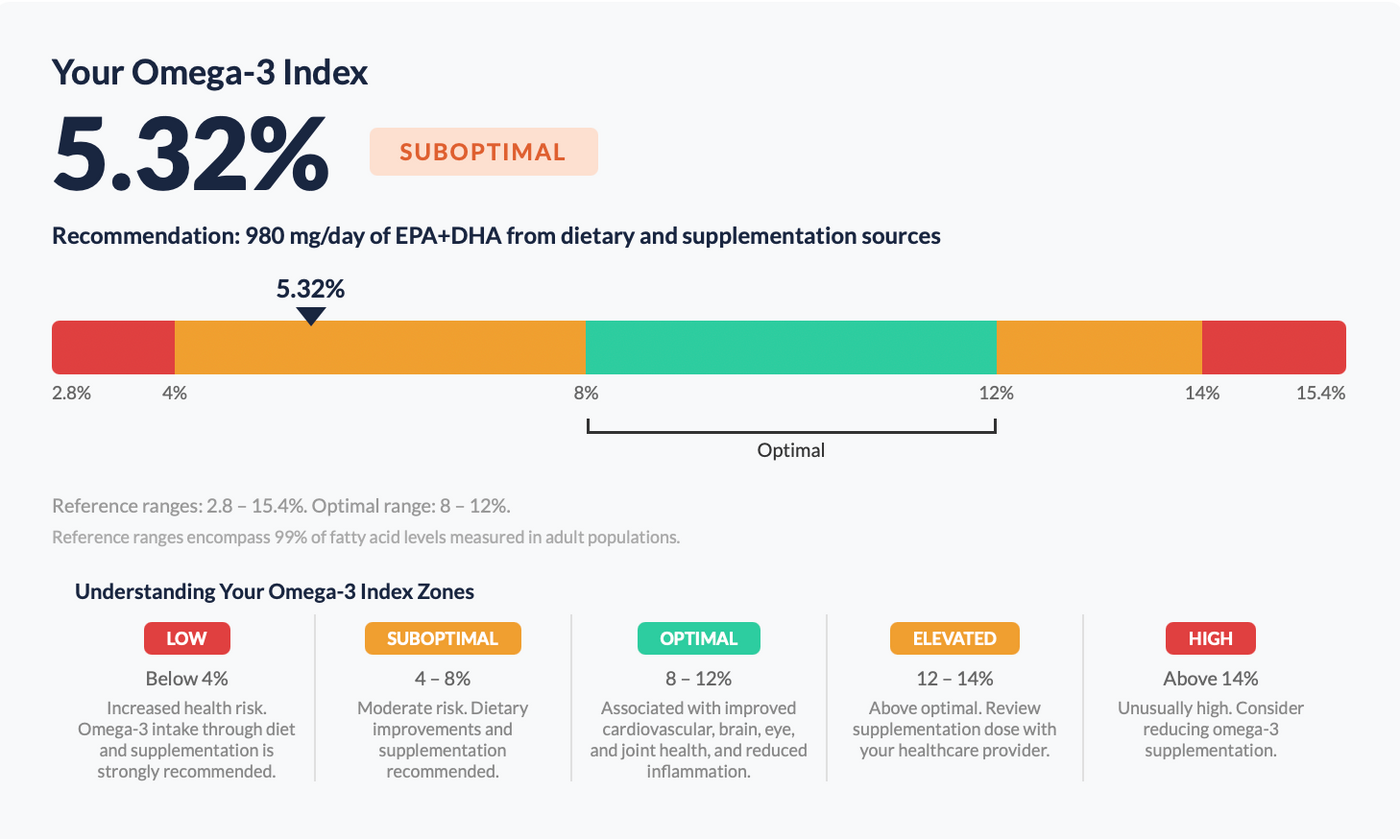
Your report has lived in your inbox for an hour and now you're staring at it. The big number, the colour-coded scale, the bracketed reference range, the technical bits at the bottom. Here's how to read it without needing a science degree.
The Omega-3 Index (the big number)
This is the headline. It's the percentage of EPA + DHA in your red blood cell fatty acids. Big number, simple unit (just a percentage). It reflects your last three to four months of intake — not what you ate yesterday.
The number sits on a coloured scale with four bands:
The ratios (Plus and Complete tests)
If you ordered the Plus or Complete test, you also see two ratios:
Omega-6 : Omega-3 ratio
Total omega-6 fatty acids divided by total omega-3 fatty acids. Reflects long-term dietary fat balance. A typical Western diet produces ratios in the 10:1 to 20:1 range. Published research suggests 4:1 or lower may be more favourable for inflammatory health. The ratio moves slowly — changing it requires sustained dietary change, not just adding an omega-3 supplement.
AA : EPA ratio
Arachidonic acid (an omega-6) divided by EPA (an omega-3). A more specific marker of inflammatory balance, because AA and EPA compete for the same enzymes that produce signalling molecules — and they push in opposite directions (AA pro-inflammatory, EPA pro-resolution). A lower AA:EPA ratio is generally considered more favourable.
The full fatty acid panel (Complete test)
If you ordered the Complete test, you'll see 24 individual fatty acids quantified. The most actionable parts are the ones already covered above (Index, ratios). The rest gives you and a healthcare practitioner a much fuller picture of dietary fat patterns — useful in clinical contexts but not always actionable on your own.
Worth noting: trans fatty acids, EPA-derived markers, and the ratio of saturated to unsaturated fats are all visible on the Complete report. These are the kinds of markers integrative GPs and dietitians often use.
What to do next — by category
Roughly:
- Low or low-end Suboptimal: the published evidence supports adding 1,000–2,000 mg/day of EPA + DHA from a quality omega-3 supplement (fish oil, krill, or algae-based for vegans/vegetarians), plus aiming for two oily-fish meals per week if fish is part of your diet. Retest in three months to confirm response.
- Mid Suboptimal (around 6%): moderate change — 500–1,000 mg/day supplementation plus dietary attention. Retest in three months.
- Optimal: maintain. Don't increase your supplement just because. The marginal benefit of going from 9% to 11% is much less clear than going from 4% to 8%.
- Elevated: discuss with your GP, especially if you're pregnant or on anticoagulants. Consider reducing supplement dose and retesting.
Important caveats
Your report is informational, not diagnostic. It measures your fatty acid status against published reference ranges — it doesn't diagnose any condition. Always discuss significant or unexpected results with your GP, midwife, obstetrician, or other qualified healthcare professional, particularly if you're pregnant, on prescription medication (especially anticoagulants), or managing a chronic condition.
Already have a kit?
Register your sample so your result lands in your account. Or order your first test — results in 3–5 days.
See our tests →Know your number.
A simple at-home finger-prick test, posted to your door. Find out where you actually stand on omega-3.
See our tests