If you buy fish oil in Australia, you may soon notice it costs more. The world's supply of fish oil has dropped to its lowest level in about a decade, krill oil has quietly disappeared from Coles and Woolworths, and Australian researchers have found that warmer oceans can lower the omega-3 content of seafood itself.
None of this is a reason to panic. It is a good reason to stop guessing and find out whether what you're taking is actually doing its job.
What's happening to fish oil supply?
Most of the world's crude fish oil comes from small oily fish, especially anchovies caught off Peru. That fishery has had a rough 2026. The Marine Ingredients Organisation (IFFO), which tracks global production, expects this year's fish oil output to be the lowest since 2016. Peru's anchovy season was repeatedly interrupted by warmer coastal water linked to El Niño, and the main North-Central fishing season was still closed in October.
At the same time, demand keeps climbing. Fish farming uses most of the world's crude fish oil, and pet food, infant formula and an ageing population all want more omega-3 too.
In October 2026, Aker BioMarine, a krill and algae oil supplier, told Nutrition Insight that omega-3 demand could outstrip crude fish oil supply as early as 2027. The company's Asia-Pacific general manager said the last big El Niño, in 2023, pushed Australian shelf prices for the whole category up about 30% in a single year. That's an industry view from a company that sells alternatives to fish oil, so treat the forecast with some caution. The supply figures behind it come from IFFO.
Why krill oil vanished from the supermarket
In September 2026, Coles and Woolworths confirmed they no longer sell krill oil supplements. Environmental groups had campaigned against krill fishing in Antarctica, where krill is a key food for penguins and whales. Some brands said their krill products had been delisted earlier for slow sales. Either way, if you used to grab krill oil with the groceries, you'll now find it mainly in pharmacies and smaller retailers.
Is the fish on your plate changing too?
A team from Adelaide University pooled 489 experiments on 132 marine species, from algae to fish, and published the results in Global Change Biology in 2026. They found that warmer water generally lowered omega-3 levels. In fish, warming of up to 6°C, which can already happen during marine heatwaves, was linked to about 19% less omega-3 in the experiments. Under extreme warming above 10°C, omega-3 concentrations in fish fell by around half.
The researchers are careful to say these were mostly short lab experiments, so the numbers don't translate directly to the salmon or sardines you buy today. But the direction is clear. The omega-3 you get from a serve of fish isn't fixed, and it may drift lower over time.
What this means for you
When a product gets dearer, the question that matters is simple: are you getting value from it? With omega-3, most people never check.
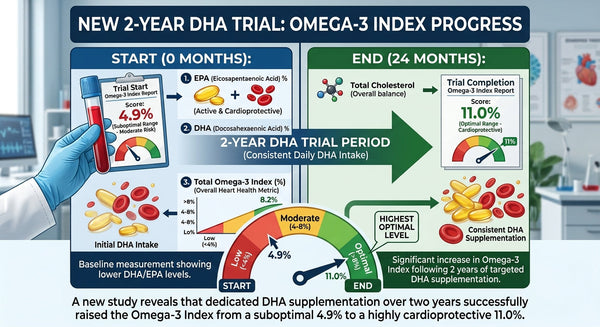
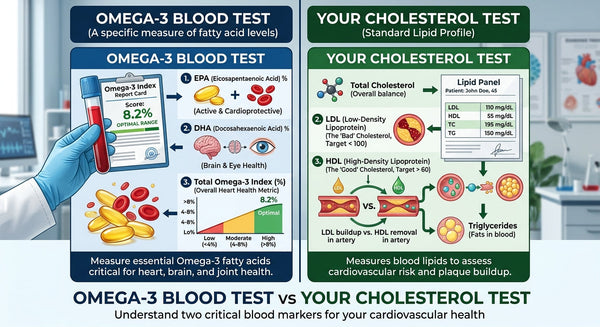
Your Omega-3 Index is the percentage of EPA and DHA in your red blood cell membranes. It reflects your intake over roughly the past three to four months, whether that comes from fish, fish oil, algae oil or krill oil. A level of 8% or higher is the range researchers describe as optimal, and 4% or lower is considered low. Most Australians sit somewhere in between, and many sit at the low end. (Here's how to read your result.)
Knowing your number helps in three practical ways when prices go up.
You might be taking more than you need. If you're already at 8% or above, you may be able to hold steady on less, or lean more on food. That's money back in your pocket.
You might be taking a product that isn't working for you. People absorb omega-3 very differently. Two people on the same capsule can end up with very different levels. If your number hasn't moved after three months, a higher-EPA and DHA product, a different form or taking it with a meal may suit you better. Without a test, you'd never know.
You can switch sources with confidence. If fish oil prices push you towards algae oil or more oily fish, a retest about three months later shows whether the swap kept your level where you want it.
Australia's ORIP trial in pregnancy is a good example of why your starting level matters: whether extra omega-3 made a difference depended largely on the levels women began with. You can read what that trial showed here.
Practical ways to keep your omega-3 up without overspending
- Check the EPA and DHA, not the "1000 mg" on the front. A standard 1000 mg fish oil capsule typically holds around 300 mg of EPA plus DHA (about 180 mg EPA and 120 mg DHA), while a concentrate can hold twice that or more. Our guide to EPA and DHA explains why both matter.
- Lean on local oily fish. Sardines, mackerel and Tasmanian salmon remain some of the richest, most affordable sources. See the best Australian fish for omega-3.
- Consider algae oil if you'd rather skip fish. It's the original source of the EPA and DHA that fish carry, and suppliers say its price gap with fish oil is narrowing.
- Estimate first, then measure. Our free omega-3 calculator gives you a rough idea from your diet and supplements. A test tells you where you actually are.
- Retest every 3 months while you're changing things. Once you've found a routine that keeps you in range, you can test less often.
For how much EPA and DHA Australian guidelines suggest each day, see how much omega-3 do you need daily?
Find your number before you stock up
The Omega-3 Index Basic test is a simple finger-prick test you do at home and post back. You'll get your Omega-3 Index with a clear explanation of what it means. If you'd like to compare with a partner, or test now and again in three months, the Omega-3 Plus Ratios Duo (2-pack) also shows your omega-6 to omega-3 balance.
If fish oil is about to cost more, it's worth knowing whether you need it, how much and which kind.
FAQ
Is there a fish oil shortage in 2026? Global fish oil production is expected to be the lowest since 2016, mainly because Peru's anchovy fishery was disrupted by warm coastal water. Supplements are still on shelves, but suppliers expect higher prices to flow through to consumers.
Will fish oil prices go up in Australia? Industry suppliers expect so. One supplier says the 2023 El Niño lifted Australian shelf prices about 30% in a year. How much prices rise this time will vary between brands and products.
Why did Coles and Woolworths stop selling krill oil? Both confirmed in September 2026 that they no longer stock krill oil supplements. Environmental groups linked the move to concerns about Antarctic krill fishing, while some brands said their products had been delisted earlier for slow sales. Krill oil is still sold in pharmacies.
Is 1000 mg of fish oil a day enough? It depends on how much EPA and DHA the capsule contains, what you eat and how your body absorbs it. A standard 1000 mg capsule typically holds around 300 mg of EPA plus DHA, but products vary widely. The only way to know whether your intake is enough for you is to measure your Omega-3 Index.
Is algae oil as good as fish oil? Algae oil provides the same long-chain omega-3s, EPA and DHA, that fish get from algae in the first place. Products differ in how much they contain, so compare the EPA and DHA per serve and check your level after switching.
Does climate change reduce omega-3 in fish? A 2026 review of 489 experiments found warmer water generally lowered omega-3 levels in marine species, including fish. Most experiments were short and done in the lab, so real-world effects on today's seafood are still being studied.
Sources
- IFFO, The Marine Ingredients Organisation. "Amid Coastal El Niño, fishmeal and fish oil output remains weak." 2026. https://www.iffo.com/amid-coastal-el-nino-fishmeal-and-fish-oil-output-remains-weak
- The Fish Site. "Fishmeal and fish oil supply could hit decade low, IFFO warns." 2026. https://thefishsite.com/articles/iffo-forecasts-lowest-fishmeal-and-fish-oil-supply-since-2016
- van Hal J. "Aker BioMarine warns omega-3 demand could outstrip fish oil supply next year." Nutrition Insight, 12 October 2026. https://www.nutritioninsight.com/news/aker-biomarine-omega-3-fish-oil-supply-shock.html
- "Krill supplements: Why Coles and Woolworths stopped sales." The Sydney Morning Herald, 2 September 2026. https://www.smh.com.au/environment/sustainability/coles-and-woolworths-drop-krill-supplements-20260902-p60toj.html
- Koe T. "Krill oil removal in Aussie supermarkets a matter of environmental concerns or sales performance." NutraIngredients, 22 September 2026. https://www.nutraingredients.com/Article/2026/09/22/krill-oil-removal-in-aussie-supermarkets-a-matter-of-environmental-concerns-or-sales-performance/
- Dawson BR, Mantzioris E, Nagelkerken I, Connell SD, Mellin C. "The Effects of Ocean Warming and Acidification on Fatty Acid Contents of Marine Organisms: A Global Meta-Analysis." Global Change Biology. 2026;32(8):e71056. https://doi.org/10.1111/gcb.71056
- Dawson BR, Mellin C, Mantzioris E. "Climate change may halve omega-3 fatty acids in fish and the organisms they eat." The Conversation, 24 August 2026. https://theconversation.com/climate-change-may-halve-omega-3-fatty-acids-in-fish-and-the-organisms-they-eat-290151
- NIH Office of Dietary Supplements. "Omega-3 Fatty Acids: Fact Sheet for Health Professionals." https://ods.od.nih.gov/factsheets/Omega3FattyAcids-HealthProfessional/
Know your number.
A simple at-home finger-prick test, posted to your door. Find out where you actually stand on omega-3.
See our tests