Australia is surrounded by ocean, yet most of us sit well below the optimal omega-3 range. Part of the reason is hiding in plain sight: not all fish are equal, and some of our most popular choices — tinned tuna, flathead, barramundi — carry far less EPA and DHA than you'd expect. Here's a plain-English guide to which local fish actually lift your omega-3, how much you need, and why your number is the only way to know you're getting there.
First, why the type of fish matters
The two omega-3s that matter most for your heart, brain and eyes are EPA and DHA — the long-chain omega-3s found in seafood. Your body carries them in your red blood cell membranes, and the percentage there is your Omega-3 Index. Australia consistently ranks in the low band on global omega-3 status maps, despite our seafood culture (more on why here).
The Heart Foundation recommends 250–500 mg of EPA + DHA per day — about 2–3 serves of fish, including oily fish, per week (one serve is roughly 100 g, palm-sized). But whether you actually hit that depends enormously on which fish you choose.
The rich sources: oily fish
These are the fish the guidelines really mean by “oily.” A single serve can deliver more EPA + DHA than a week of leaner choices:
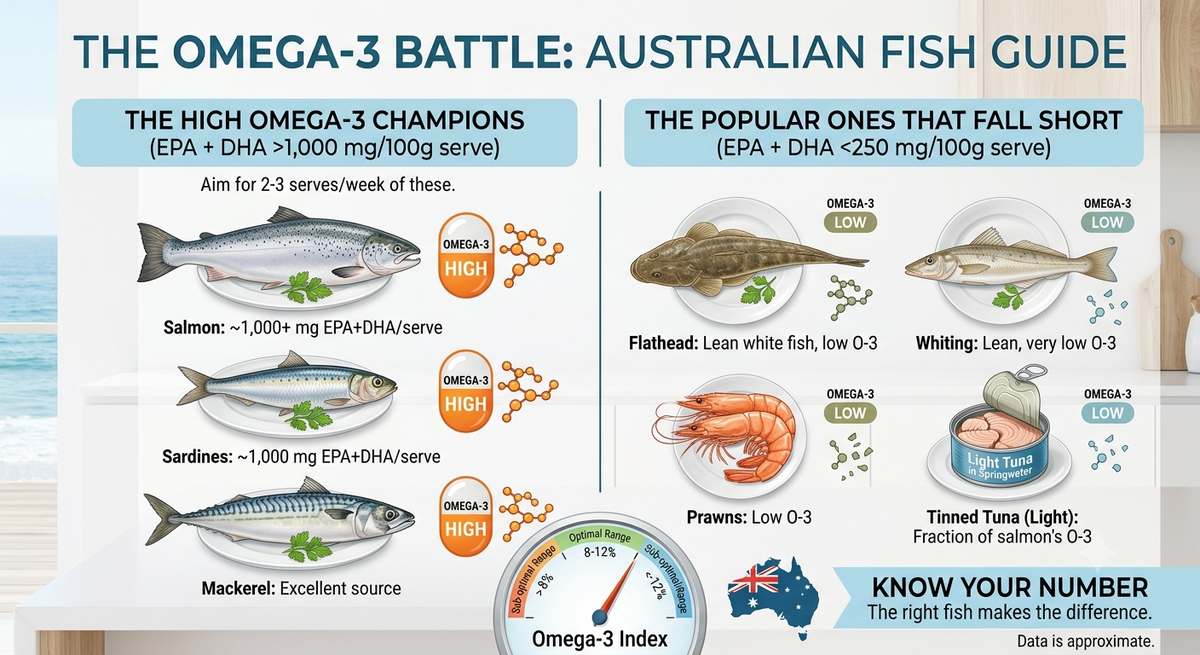
- Salmon (Tasmanian Atlantic) — one of the richest, comfortably over 1,000 mg EPA + DHA per 100 g serve.
- Sardines — around 1,000 mg per 100 g, inexpensive and sustainable; tinned counts.
- Mackerel (Atlantic/blue), herring and rainbow trout — all excellent sources.
Eat one or two servings of these a week and you're doing most of the work.
The moderate sources
- Barramundi (farmed) — about 650 mg per serve, and more if you eat the skin; wild barramundi is leaner.
- Snapper and albacore (“white”) tuna — useful but middle-of-the-road (roughly 250–1,000 mg per serve).
The popular ones that fall short
This is where a lot of Australians go wrong — eating fish regularly, but the wrong fish for omega-3:
- Light tinned tuna (skipjack/yellowfin in springwater) — often under 250 mg per serve, a fraction of salmon or sardines.
- Flathead, whiting, bream — lean white fish, low in EPA + DHA.
- Prawns, calamari and most shellfish — low.
Quick reference: Australian seafood by omega-3
| Seafood | Omega-3 (EPA+DHA) per 100 g serve |
|---|---|
| Salmon (Atlantic), sardines, mackerel | High (>1,000 mg) |
| Trout, herring, farmed barramundi (with skin) | Good (~650–1,000 mg) |
| Snapper, albacore tuna, wild barramundi | Moderate (250–1,000 mg) |
| Light tinned tuna, flathead, whiting, prawns | Low (<250 mg) |
Figures are approximate and vary with species, season, farmed vs wild, and cooking — but the tiers hold. For a fuller list, see our guide to omega-3 in seafood.
How much do you actually need?
The Heart Foundation's 250–500 mg/day works out to two or three servings of oily fish a week. For most healthy people, food comes first. Omega-3 supplements are mainly considered for people with existing heart disease or high triglycerides — and even then, dose matters. Our daily omega-3 guide walks through the numbers.
The catch: you can't feel your level
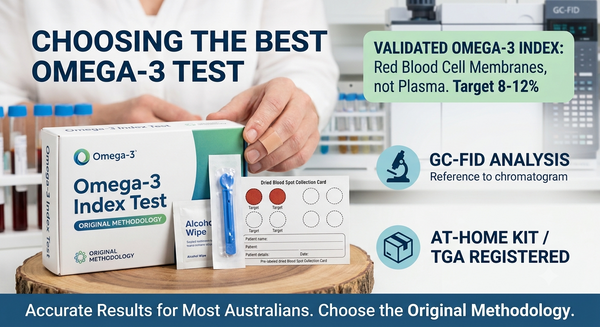
Here's the honest part. Even if you eat oily fish, how much ends up in your blood depends on your dose, your consistency and your own metabolism — and red blood cell levels take 8–12 weeks to reflect a change. You can't feel whether you're in the optimal 8–12% range or sitting low. The only way to know is to measure your Omega-3 Index — a simple at-home finger-prick, analysed by the same GC-FID method used in published research. (Wondering how accurate at-home tests are? Our honest answer.)
Find out where you actually stand
Measure your Omega-3 Index from one finger-prick. Posted to your door, results in 3–5 days.
Order — $89.95 →References
- Heart Foundation (Australia). Omega-3, omega-6 and heart health.
- Stark KD, et al. Global survey of the omega-3 fatty acids in healthy adults. Progress in Lipid Research. 2016;63:132–152.
- Harris WS, von Schacky C. The Omega-3 Index: a new risk factor for death from coronary heart disease? Preventive Medicine. 2004;39(1):212–220.
- FishFiles / Fisheries Research and Development Corporation (FRDC). Omega-3 content of Australian seafood.
- US National Institutes of Health, Office of Dietary Supplements. Omega-3 Fatty Acids fact sheet.
This article is general information, not medical advice, and does not diagnose, treat or prevent any condition. Discuss dietary or supplement changes with your GP, especially in pregnancy or if you take medication.
Know your number.
A simple at-home finger-prick test, posted to your door. Find out where you actually stand on omega-3.
See our tests