If you've been searching for an at-home omega-3 test, you've probably also stumbled across articles warning that at-home blood tests "aren't accurate." Some of those warnings apply to other categories of self-testing. Almost none of them explain whether they apply to omega-3 testing — and the honest answer is mostly no, with important caveats about which at-home omega-3 test you choose.
Here's the short version: every legitimate omega-3 test on the Australian market — whether ordered by a practitioner or bought as an at-home kit — relies on the same underlying laboratory technique. The sample might be a venous draw at a clinic or a finger-prick collected at your kitchen table, but the analysis happens in a lab. The accuracy of an at-home omega-3 test therefore comes down to which lab does the analysis, what method they use, and whether the at-home collection step has been formally validated against the clinic standard.
This guide explains where the legitimate accuracy concerns about home testing come from, why they don't translate one-to-one to omega-3, and the five questions worth asking before you order any at-home omega-3 test.
The short version
- There is no instant home-readable omega-3 test. Every omega-3 result you can get in Australia — at-home or in clinic — is produced by a laboratory.
- For an at-home omega-3 test, the accuracy question is really four questions: which lab, what method, is the lab accredited, and is the at-home collection method validated against the clinic standard.
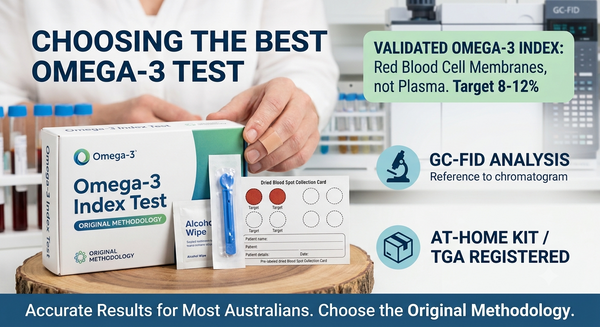
- The reference method for fatty acid analysis is GC-FID (gas chromatography with flame ionisation detection) — the same method used in the published research that defines the Omega-3 Index.
- For dried blood spot (DBS) — the small finger-prick sample posted to the lab — paired-sample studies show correlation of R² > 0.96 against the gold-standard red blood cell (RBC) measurement when both are analysed by GC-FID.
- Australian consumers should look for NATA-accredited laboratories (the local equivalent of ISO 15189), participation in external quality assessment (like DEQAS), and a TGA-registered collection kit.
Why people worry about at-home test accuracy
The "at-home tests aren't accurate" worry isn't groundless — it's just usually about a different category of test. Self-tests that you read at home in minutes do exist for COVID antigens, pregnancy, blood glucose, and ovulation. They rely on antibody-based or enzyme-based chemistry that can be packaged into a single-use device. Their accuracy varies, and reasonable people have written reasonable critiques of the weaker ones.
Omega-3 testing doesn't sit in that category at all. EPA and DHA — the long-chain omega-3 fatty acids that matter for your Omega-3 Index — are quantified by physically separating them out of a blood sample and measuring each one individually. That requires laboratory chromatography. There is no antibody or single-use device that can do it at your kitchen table, and no Australian-market omega-3 product claims otherwise.
So when you see an at-home omega-3 kit, what you're really buying is a clinic-grade pathology test with the sample-collection step shifted to your home. A small finger-prick blood sample is collected onto a dried blood spot (DBS) card, posted in a reply-paid envelope, and analysed by the lab. The accuracy question is about the lab and the validation work behind the DBS step — not about a device you read at home.
What omega-3 testing actually looks like in Australia
It helps to be honest about the broader landscape, because most Australians have never had their omega-3 status measured at all.
1. Routine GP pathology — usually doesn't cover it
Standard pathology panels ordered by a GP don't include the Omega-3 Index. Cholesterol, triglycerides, liver enzymes and the rest of the routine panel say nothing about your EPA and DHA levels. If you've never specifically asked for an omega-3 test, you almost certainly haven't had one.
2. Specialist or research-lab requests
Some integrative GPs and dietitians can order an Omega-3 Index through specialist pathology providers. This is uncommon, and out-of-pocket cost varies. The lab method used depends on the provider.
3. At-home mail-in finger-prick kits
This is our category, and the one growing fastest in Australia. You collect a small finger-prick sample onto a DBS card at home, post it back, and the lab analyses it. You get a PDF report a few days later. The collection happens at home; the analysis happens in an accredited laboratory.
The variability between at-home omega-3 brands is therefore not about "rigorous vs DIY." It's about which lab and which method sit behind the brand on the box.
What actually determines accuracy in an at-home omega-3 test
Five things separate a result you can trust from a result you can't.
1. Where the sample is analysed, and by what method
The reference method for fatty acid analysis is gas chromatography with flame ionisation detection (GC-FID). It physically separates each fatty acid out of the blood sample and quantifies each one independently. It's the method used in essentially every published omega-3 trial that underpins international clinical guidelines — including the original Omega-3 Index methodology described by Harris & von Schacky in 2004, and the large international comparison of blood omega-3 status published by Stark and colleagues in 2016.
Cheaper, faster alternatives exist. If a brand doesn't explicitly say their lab uses GC-FID, assume it doesn't.
2. Whether the methodology is the original Omega-3 Index
"Omega-3 Index" isn't just a brand name — it's a specific methodology, with a published reference scale (target ≥ 8%, low-risk ≥ 8%, high-risk < 4%) built from more than 450 peer-reviewed studies. Labs licensed to deliver the original methodology produce results that sit on that scale. Other labs may quote a similar-sounding number generated a different way, which won't sit neatly on the published reference scale.
3. Lab accreditation
Accreditation tells you the lab operates a documented quality system, calibrates its equipment to known standards, runs internal control samples, and is independently audited. In Australia, the relevant accreditation is NATA (the National Association of Testing Authorities), which assesses pathology labs to the international standard ISO 15189.
An unaccredited "lab" is a back-room operation — even if the equipment looks the same, there's no independent assurance the results are correct.
4. External quality assessment
Accredited labs also participate in external quality assessment schemes that send blind samples to participating laboratories and compare results. For fatty acid work, the most respected scheme is DEQAS. Participation is voluntary, and labs that take part are publicly telling the world they're confident their numbers will line up with everyone else's.
5. Validation of the at-home collection step
Shifting sample collection from a clinic chair to a kitchen table is only defensible if the dried blood spot method has been formally validated against the clinic gold standard — a paired-sample study where the same people give both a DBS sample and a venous blood draw, and both are analysed by GC-FID.
For omega-3, the published literature is reassuring: DBS correlates with venous RBC measurements at R² > 0.96. Fatty acids are remarkably stable on the collection card at room temperature, which is why DBS-based omega-3 testing has been used in published research for over a decade, including in the dose-response work of Walker and colleagues (2019) and in large population studies.
How our test stacks up
Here are the answers for our kit, point by point:
- Methodology: The original Omega-3 Index, developed by Harris and von Schacky. We are the first Australian laboratory — and the only laboratory in the Asia-Pacific region — licensed to deliver the original Omega-3 Index methodology. Your result sits on the same reference scale used in 450+ published studies.
- Lab method: Gas chromatography with flame ionisation detection (GC-FID), the reference method for fatty acid analysis.
- Lab: Accredited Australian laboratory operating under documented quality systems aligned to ISO 15189.
- External quality assessment: Our lab participates in external proficiency programs to confirm results are comparable to other reference laboratories internationally.
- DBS validation: R² > 0.96 correlation between dried blood spot results and the gold-standard RBC-based Omega-3 Index, both analysed by GC-FID.
- Quality control: Every result passes automated QC checks; any out-of-range or unusual result is reviewed by a qualified scientist before it leaves the lab.
- Regulatory: Collection kit registered on the Australian Register of Therapeutic Goods, ARTG 526367 (Class IIa Medical Device). Manufactured in Australia by Masdiag Pty Ltd. View the TGA listing.
In plain English: the finger-prick step is the only thing that changes between our at-home test and a clinic blood draw. The lab, the method, and the reference scale are the same ones used in the published research. More on how we test, or read the underlying science.
5 questions to ask before you order any at-home omega-3 test
- Where is the sample analysed, and by what method? The answer should be a named, accredited laboratory using GC-FID. If a brand can't name the lab or the method on their website, that tells you something.
- Is the methodology the original Omega-3 Index? A result that sits on the published reference scale (target ≥ 8%) means something different to a number generated a different way. Ask which scale your result will be reported against.
- Is the lab accredited — and to which standard? NATA accreditation to ISO 15189 is the cleanest answer for an Australian consumer. Beware vague claims like "lab-grade" or "clinical-grade" without a specific accrediting body named.
- Has the dried blood spot collection been validated against venous RBC analysis, and what's the correlation? Look for published R² values around 0.95 or higher. Vague accuracy claims without numbers are a red flag.
- Is the kit registered on the ARTG? Ask for the number, and verify it on the TGA's public register. ARTG registration means an independent regulator has reviewed the kit's design, manufacture, and quality control.
The honest answer
So — are at-home omega-3 tests accurate? The phrase "at-home test" only describes where the sample is collected; the analysis still happens in a laboratory. For omega-3 specifically, an at-home finger-prick analysed at an accredited Australian lab by GC-FID is, for practical purposes, the same as a clinic venous draw analysed by the same method. The collection method has been formally validated, the lab method is the published reference standard, and the result sits on the same scale used in the research literature.
That doesn't mean every at-home omega-3 kit on the market is built that way. Some are run through labs that don't use GC-FID, or report numbers that don't sit on the original Omega-3 Index reference scale, or skip external quality assessment, or aren't ARTG-registered. The five questions above will tell you which kind you're looking at — and they're the same questions a thoughtful GP would ask before trusting a pathology report.
Ready to test? Our Omega-3 Index Basic is $89.95 and measures your Omega-3 Index (EPA + DHA as % of total fatty acids). Plus Ratios ($99.95) adds your omega-6 : omega-3 and AA : EPA inflammatory ratios. Complete ($109.95) is the full 24-fatty-acid profile. The Prenatal Omega-3 Test ($89.95) is tuned for pregnancy.
References
- Harris WS, von Schacky C. The Omega-3 Index: a new risk factor for death from coronary heart disease? Preventive Medicine, 2004.
- Stark KD, Van Elswyk ME, Higgins MR, Weatherford CA, Salem N. Global survey of the omega-3 fatty acids, docosahexaenoic acid and eicosapentaenoic acid in the blood stream of healthy adults. Progress in Lipid Research, 2016.
- Walker RE, Jackson KH, Tintle NL, et al. Predicting the effects of supplemental EPA and DHA on the omega-3 index. The American Journal of Clinical Nutrition, 2019.
Know your number.
A simple at-home finger-prick test, posted to your door. Find out where you actually stand on omega-3.
See our tests