

Not all at-home tests are equal.
Every part of our process is accredited, externally verified, and quality-reviewed.
Licensed Omega-3 Index methodology
Licensed to deliver the Omega-3 Index using the original methodology defined by Harris & von Schacky (2004) and referred to in more than 500 published papers.
GC-FID reference method
Your sample is analysed using gas chromatography with flame ionisation detection — the reference method for fatty acid analysis, the same one used in the published omega-3 trials underpinning international clinical guidelines.
TGA-registered kit
Our collection kit is a Class IIa Medical Device (ARTG 526367), manufactured in Australia.
Quality-reviewed results
Every result passes through automated QC checks. Out-of-range results are reviewed by a qualified scientist before release.
Accredited laboratory
Sample analysis at an accredited laboratory. R² greater than 0.96 correlation with the gold-standard RBC-based Omega-3 Index method.
Your GP can't measure this.
The Omega-3 Index isn't part of any routine blood panel in Australia. Standard pathology measures different things — useful ones, but not your omega-3 status.
Standard pathology panel
- No EPA + DHA measurement
- No Omega-3 Index
- No omega-6 : omega-3 ratio
- No AA : EPA inflammatory ratio
- No personalised supplement dose
Omega-3 Index Test
- EPA + DHA as % of red blood cell fatty acids
- Your Omega-3 Index on the 8–12% optimal scale
- Omega-6 : Omega-3 ratio (with Plus Ratios)
- AA : EPA inflammatory ratio (with Plus Ratios)
- Personalised daily EPA+DHA dose
Calculate your personalised omega-3 dose.
Once you have your result, plug it into our calculator with your target and current intake to get a daily EPA+DHA dose recommendation. Based on the Walker et al. (2019) dosing model used in published clinical trials.
- Based on Walker et al. (2019) dosing model
- Works whether you supplement or not
- Free to use — no email required
Common questions
Everything you need to know before ordering.
I've read at-home blood tests aren't accurate — what's different about yours?
You can't get an Omega-3 Index from your GP. Standard pathology panels measure cholesterol, vitamin D, glucose, iron — none measure EPA + DHA as a percentage of your red blood cell membranes. The only way to get an Omega-3 Index is from a lab specifically set up for fatty acid analysis.
Our test uses the original Omega-3 Index methodology defined by Harris & von Schacky (2004) in their landmark paper in Preventive Medicine, and today more than 500 published papers refer to the Omega-3 Index. The finger-prick is just the collection method — your dried blood spot is analysed in an accredited laboratory using GC-FID, the reference method for fatty acid analysis, with R² > 0.96 correlation against gold-standard RBC-based analysis.
How accurate is the at-home finger-prick test?
The dried blood spot (DBS) method is well-validated for fatty acid analysis and shows R² > 0.96 correlation with the gold-standard RBC-based Omega-3 Index. Fatty acids are stable on the collection card at room temperature for several weeks, which is why samples can be safely posted across Australia without refrigeration.
Can I get my results in my own language?
Yes. Your results report is available in 11 languages: Czech, Danish, German, English, Spanish, French, Italian, Lithuanian, Dutch, Swedish and Chinese (Simplified).
How much does an Omega-3 Index test cost, and is it covered by Medicare?
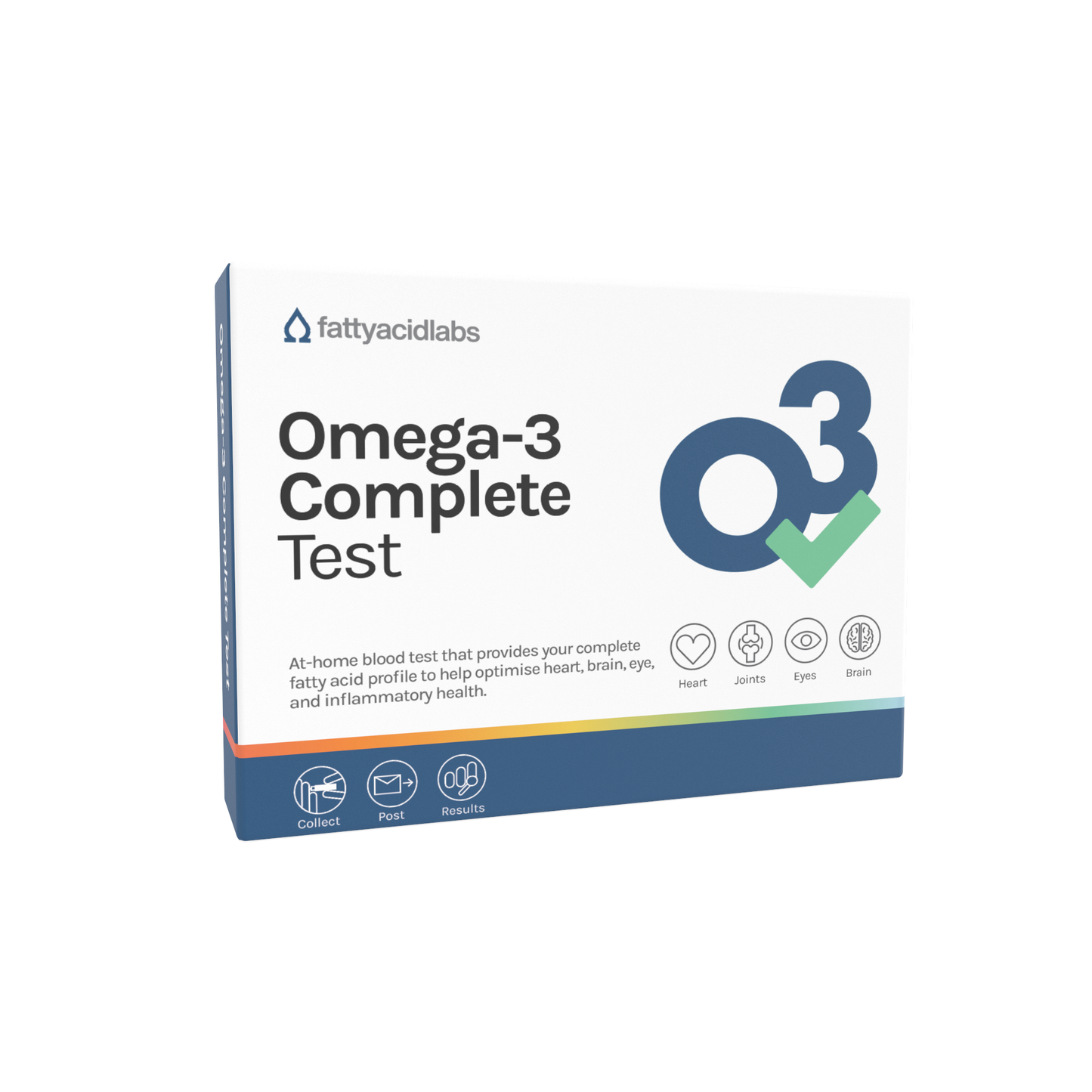
The Omega-3 Index Basic test is $89.95 including GST, with free Australia-wide shipping. Plus Ratios is $99.95 and Complete (24 fatty acids) is $109.95. 2-packs cost less per test. The Omega-3 Index is not part of routine pathology, so it isn't covered by Medicare. More on Medicare and the Omega-3 Index.
How is an Omega-3 Index test different from other omega-3 blood tests?
The Omega-3 Index is one specific measurement: EPA + DHA as a percentage of the fatty acids in your red blood cell membranes, reported against the 8–12% target range. It was defined by Harris & von Schacky (2004), and more than 500 published papers refer to the Omega-3 Index. Some other omega-3 tests report different measures, for example plasma levels or a general fatty-acid panel, which can't be compared directly with the 8–12% Omega-3 Index scale.
Do I need to fast before the test?
No. Your omega-3 status reflects intake over the previous 3–4 months — it isn't meaningfully affected by recent meals. Just avoid alcohol and intense exercise on the day of collection.
How long until I get my results?
Typically 3–5 business days from when the lab receives your sample. We email you when your report is ready.
When should I retest?
Red blood cells turn over roughly every 120 days, so your Omega-3 Index reflects the last 3–4 months. If you change your diet or supplements, retest after about 3 months to see the change. Our 2-packs include a second kit for this.
What does the report look like?
Your report shows your Omega-3 Index, where it sits on the 8–12% target scale, and a personalised daily EPA + DHA amount. See a sample report.
Will my GP accept these results?
Yes. Your report is formatted with the same structure you'd see from a pathology lab — analyte, methodology, reference ranges, and result. Many Australian GPs, integrative practitioners, midwives, and obstetricians already use omega-3 results in clinical conversations.
Is the kit TGA-registered?
Yes. Our test kit is registered on the Australian Register of Therapeutic Goods as a Class IIa Medical Device (ARTG 526367), manufactured in Australia. View the TGA listing.
Stop guessing. Know your level.
A simple at-home finger-prick test, posted to your door. Free Australia-wide shipping. Results in 3–5 days.