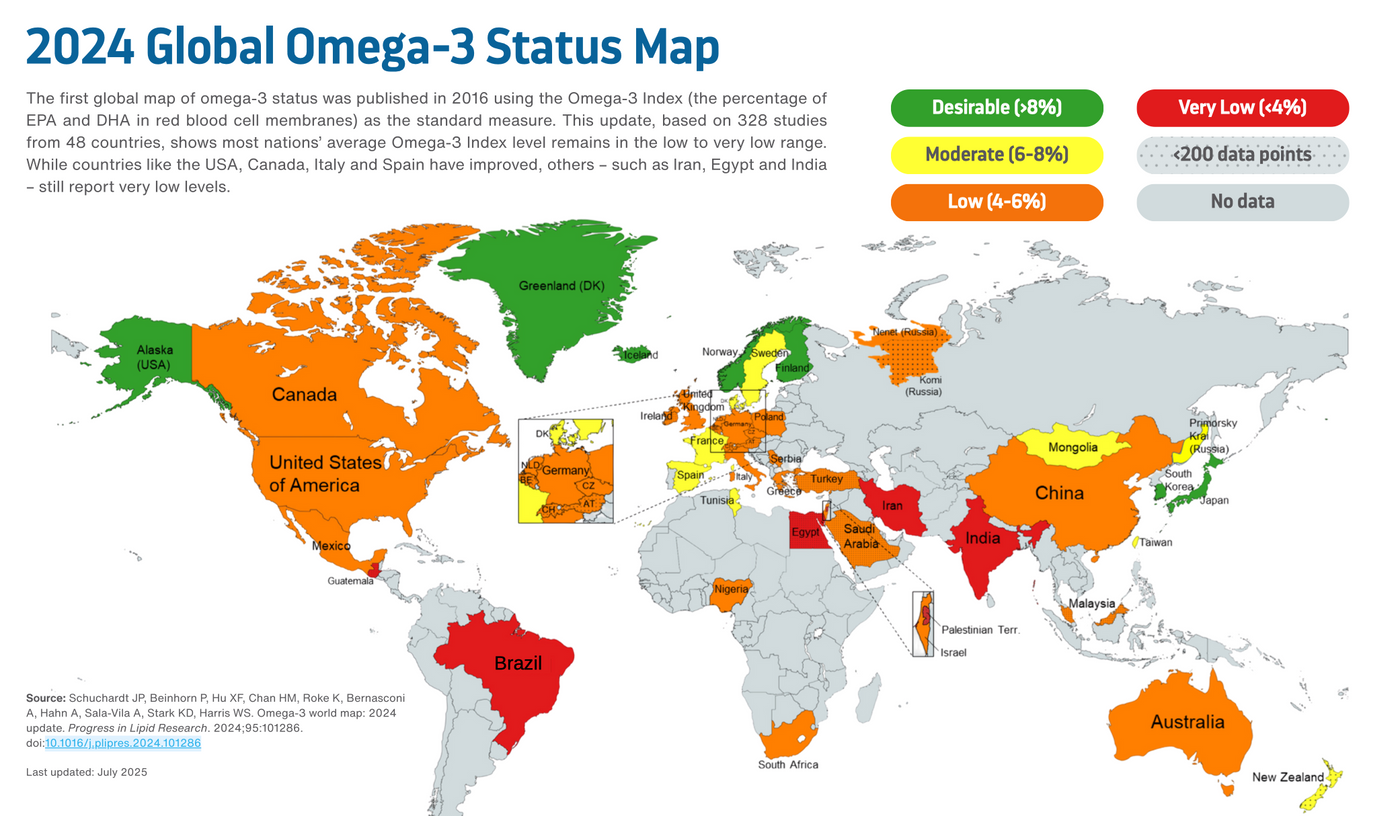
Australia thinks of itself as a fish-eating country. The truth is that, on the published omega-3 status data, we sit closer to the bottom of the global table than the top. The average Aussie has an Omega-3 Index of 4–6% — well below the 8–12% range linked in published research to better cardiovascular outcomes.
The global picture
In 2016, Ken Stark and colleagues published the first comprehensive global survey of omega-3 status in Progress in Lipid Research. They pulled together data from population studies in 54 countries, classified by region, and produced the first proper map of where the world stands.
The map showed enormous variation. Populations with traditionally high seafood consumption — Japan, South Korea, parts of Scandinavia, several Pacific island nations — typically had Omega-3 Index levels of 8% or higher. Populations with lower seafood consumption — most of Western Europe, North America, Central and South America, and Australia/New Zealand — sat much lower, often in the 4–6% band.
That places Australia squarely in the "low" band on the global map. A more recent 2024 update of the global survey, drawing on additional cohort data, confirms the pattern. And a 500,000+ sample analysis published using dried blood spot data tells the same story: most of us, in countries like ours, are below where the science suggests we should be.
Why Australia is low
The simple answer: we don't eat enough oily fish.
The Heart Foundation recommends two to three serves of oily fish per week (salmon, sardines, mackerel, herring, trout). The most recent national nutrition surveys suggest the average Australian eats fish around once a week or less, and a substantial portion of that is white fish or tuna — which is much lower in EPA and DHA than oily fish.
Add to that:
- Vegetable-oil-heavy modern diets — sunflower, soybean, canola, corn oils dominate cooking and processed food. They're rich in omega-6 linoleic acid, which competitively inhibits the conversion of plant-based ALA (the omega-3 in flax, chia, walnuts) into EPA and DHA.
- Conversion is inefficient anyway — only 5% or less of dietary ALA is converted to EPA in adults, and conversion to DHA is even lower (often less than 1%).
- Seafood cost and convenience — Australian seafood is relatively expensive, and a meaningful portion is exported.
Net result: even Australians who think they eat "a fair bit of fish" often don't get enough EPA + DHA to push their Omega-3 Index above the suboptimal band.
Why it actually matters
The 8% optimal threshold isn't an arbitrary marketing number. It comes from observational research linking Omega-3 Index levels to cardiovascular outcomes — the original Harris and von Schacky 2004 paper proposed 8% as a target for reduced sudden cardiac death risk. Subsequent observational research, including pooled analyses across more than 50,000 participants, has consistently linked higher Index levels with lower all-cause and cardiovascular mortality.
Beyond cardiovascular health, lower Omega-3 Index has been associated with cognitive markers, mood, inflammatory load, and visual function. The pregnancy-specific evidence — covered in a separate article — is even stronger, with randomised trial data showing reductions in early preterm birth in women who start with low DHA.
What this means if you live here
Three things to know:
One: assume you're probably below 8% unless you specifically eat oily fish two-plus times per week or you've been on a meaningful EPA + DHA supplement for at least three months.
Two: the gap is small in numerical terms (you might need to add 200–500 mg/day of EPA + DHA to close it) but you have no idea where you actually are without measuring.
Three: if you're going to act, measure first. Without a baseline, you don't know whether what you're doing is working — and you can't tell when you've reached the optimal range.
Find out where you actually stand
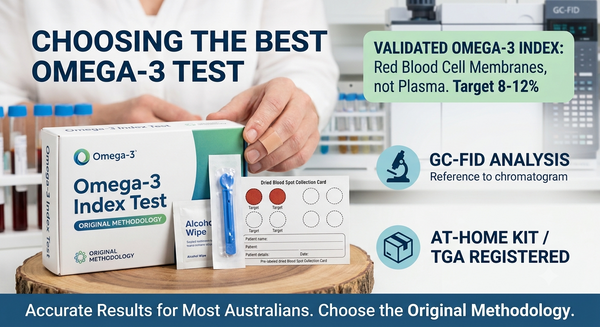
Our Omega-3 Index Basic test measures EPA + DHA from a finger-prick. Posted to your door, results in 3–5 days.
Order — $89.95 →References
- Stark KD, Van Elswyk ME, Higgins MR, Weatherford CA, Salem N. Global survey of the omega-3 fatty acids in healthy adults. Progress in Lipid Research. 2016;63:132-152.
- Harris WS, von Schacky C. The Omega-3 Index: a new risk factor for death from coronary heart disease? Preventive Medicine. 2004;39(1):212-220.
- Heart Foundation of Australia. Fish, seafood and heart health: position statement.
- Australian Bureau of Statistics. Australian Health Survey: Nutrition First Results — Foods and Nutrients.
Know your number.
A simple at-home finger-prick test, posted to your door. Find out where you actually stand on omega-3.
See our tests