From 2026, South Australia became the first jurisdiction in the world to offer omega-3 status testing free to all pregnant women through SA Pathology. It's the result of more than fifteen years of research led by Professor Maria Makrides, Dr Karen Best and the team at SAHMRI — and it's a big deal for how preterm birth is prevented in this country.
How we got here — three landmark Australian trials
DOMInO (2010)
The first signal. A randomised controlled trial of 2,399 women across five Australian centres, published in JAMA. Half the women received DHA-rich fish oil during the second half of pregnancy; half received a placebo. The primary outcome (childhood neurodevelopment) didn't show a clear benefit — but a secondary signal did: women in the DHA group had fewer early preterm births.
Cochrane Review (Middleton et al., 2018)
The big pooled-evidence picture. A systematic review of more than 70 studies and approximately 20,000 women. The review found omega-3 supplementation in pregnancy reduced overall preterm birth by 11% — and crucially, reduced early preterm birth (before 34 weeks gestation) by 42%.
Early preterm birth (before 34 weeks) is the kind that matters most: babies born this early have meaningfully higher rates of serious illness and mortality. A 42% reduction is enormous in public health terms.
ORIP Trial (Makrides et al., 2019)
The world's largest single trial. 5,517 women across multiple Australian sites, published in the New England Journal of Medicine. ORIP delivered the finding that changed the conversation: omega-3 supplementation in pregnancy doesn't benefit all women equally. The benefit depends on baseline omega-3 status.
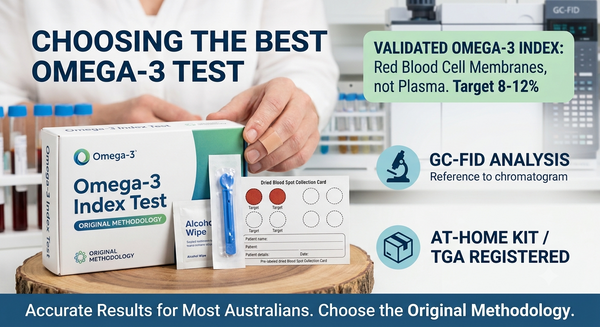
Specifically: women who started pregnancy with low DHA levels (≤ 4.1% of red blood cell fatty acids) and were given 900 mg/day of higher-dose DHA supplementation showed substantial reductions in early preterm birth. Women who started with already-adequate levels did not see the same benefit — and in subgroup analysis from Simmonds et al. (BJOG 2020), there was a hint that supplementation when not needed may not be neutral.
From research to routine care: the SA Test-and-Treat Program
Building on this, SAHMRI partnered with SA Pathology to deliver the Omega-3 Test-and-Treat Program. From 2021 to 2025 they ran statewide implementation work, demonstrating that omega-3 status testing alongside tailored supplementation advice could be embedded within existing antenatal blood work — without requiring extra appointments or extra blood draws for women.
The implementation evidence was published in the Medical Journal of Australia in 2025 (Best et al.). It showed the program was feasible, equitable, and adopted by clinicians — the prerequisites for permanent integration into routine care.
From 2026, omega-3 testing is now offered to all pregnant women in South Australia as part of routine antenatal blood work. National rollout is in progress, with SAHMRI working with health partners across other states.
What this means for women
If you're pregnant in South Australia: ask your GP or midwife about the omega-3 status test. It's part of your routine antenatal care now, free, and built into your existing pathology requests.
If you're pregnant outside South Australia: the test isn't yet routinely offered through Medicare. The clinical case is identical, but the funded program hasn't reached you yet. Our at-home Prenatal Omega-3 Test gives you the same measurement, posted from home, anywhere in Australia. Same analyte, same reference ranges.
If you've had the SA test once and want to monitor: the SA program offers a baseline test. If your level is low and you start supplementing, you'll want to confirm your level is responding. DHA in red blood cells takes 2–3 months to fully reflect supplement changes — so a follow-up test at 8–12 weeks lets you confirm the supplement is doing what you expect.
If you're planning pregnancy: building your status before conception is a low-friction win. If you're below the optimal range, starting 3–6 months before trying gives your body time to reach adequacy.
If you don't eat fish or fish-derived products: algae-based omega-3 supplements provide an equivalent DHA source for women who are vegan, vegetarian, or otherwise avoiding fish. The DHA your body incorporates into red blood cells is the same molecule regardless of whether it originated in fish oil or microalgae.
What the program isn't
It isn't a guarantee. The 42% reduction figure refers to the average effect across pooled trials in defined populations. Individual outcomes depend on individual factors. Preterm birth has many causes, only one of which is omega-3 status.
It also isn't a substitute for the rest of antenatal care. The omega-3 test sits alongside everything else: blood pressure monitoring, glucose tolerance, infection screening, ultrasound, and the conversations you have with your midwife or obstetrician about your specific pregnancy.
What it is: a precise, evidence-based way to decide whether higher-dose omega-3 supplementation is likely to benefit you specifically — instead of guessing.
Pregnant or planning?
Our Prenatal Omega-3 Test gives you the same monitoring at home, anywhere in Australia.
Order the test — $89.95 →References
- Makrides M, Gibson RA, McPhee AJ, et al. DHA supplementation during pregnancy and neurodevelopment of young children (DOMInO). JAMA. 2010;304(15):1675-1683.
- Middleton P, Gomersall JC, Gould JF, et al. Omega-3 fatty acid addition during pregnancy. Cochrane Database of Systematic Reviews. 2018;11:CD003402.
- Makrides M, Best K, Yelland L, et al. A Randomized Trial of Prenatal n-3 Fatty Acid Supplementation and Preterm Delivery (ORIP). NEJM. 2019;381:1035-1045.
- Simmonds LA, Sullivan TR, Skubisz M, et al. Omega-3 fatty acid supplementation in pregnancy — baseline omega-3 status and early preterm birth. BJOG. 2020;127(8):975-981.
- Best KP, Northcott C, Simmonds LA, et al. Feasibility, Implementation and Early Adoption of an Omega-3 Test-and-Treat Program. Medical Journal of Australia. 2025.
- SAHMRI — Omega-3 Test-and-Treat Program overview.
Know your number.
A simple at-home finger-prick test, posted to your door. Find out where you actually stand on omega-3.
See our tests