Even athletes who treat training, sleep and recovery like a full-time job can miss one number. A 2026 University of Wollongong study — the first large, multi-sport look at the Omega-3 Index in highly trained Australian athletes — found that most were still well short of the 8% band often used as a long-term target.
The paper was published in Sports Medicine – Open. Here is what it found, and what it means if you train hard but rarely eat oily fish.
What the researchers measured
- 595 athletes, aged 18–45, from 17 sports across several Australian states (including Australian football, rugby union and league, soccer, athletics, cricket, hockey, swimming, cycling, netball and basketball).
- All were Tier 3–5: highly trained, elite or world-class.
- Each gave a dried blood spot for fatty-acid analysis; the Omega-3 Index was derived with a validated conversion.
- A dietary survey (in a large subset) estimated daily EPA + DHA from seafood and supplements.
The headline numbers
| Finding | Result |
|---|---|
| Mean Omega-3 Index | 5.88% |
| Below 4% | 3% of athletes |
| 4–6% | 60% |
| 6–8% | 30% |
| At or above 8% | Only 7% |
| Median EPA + DHA intake | 261 mg/day |
| Under 500 mg EPA + DHA/day | 72% |
| Reporting omega-3 supplement use | 19% |
Supplement users had a higher median Index (7.02%) than non-users (5.38%). Male athletes averaged higher Index values than females despite similar reported intake — another reminder that the same plate of fish does not produce the same blood level in everyone.
Why an “athlete” diet can still leave you short
Australian footballers, rugby players and endurance athletes often eat carefully. They still face the same barriers as everyone else: dislike of fish, busy schedules, and little feedback on whether fish oil is doing anything.
The Heart Foundation suggests most adults aim for about 250–500 mg of EPA + DHA a day, roughly two to three serves of oily fish a week. Nearly three-quarters of these elite athletes were under 500 mg. Only about one in ten reported two or more oily-fish meals a week. The Australian Institute of Sport Supplement Framework lists EPA and DHA as nutrients that can support athlete health — but intake still has to land in the blood.
What this does not prove
This was a cross-sectional snapshot, not a trial that tested performance, recovery or injury rates. It does not show that raising the Omega-3 Index will make you faster, stronger or less sore. Omega-3 supplements are not a treatment for heart disease or any other condition. Talk to your doctor or sports dietitian before high-dose supplements, especially if you take anticoagulants or compete under anti-doping rules.
What it does show clearly: even among Australia’s best-supported athletes, most had not reached an 8% Omega-3 Index, and dietary EPA + DHA was modest.
A practical approach for active Australians
- Measure first with an Omega-3 Index test. Guessing from your capsule label is unreliable — the same dose can leave two people several percentage points apart (the same “test, don’t guess” idea we covered in the ORIP trial).
- Estimate a dose for your starting level with the EPA + DHA calculator, rather than a bottle default.
- Build food in where you can: our guide to best Australian fish for omega-3 and how much omega-3 per day cover realistic plates.
- Retest after three months, when most of the change shows in your red blood cells, then read your result.
You do not need to be Tier 5 to care about the number. If you train regularly, skip fish most weeks, or take fish oil “sometimes”, this study is a useful mirror: status is knowable, and most people who look carefully are not at 8% yet.
FAQ
What is a good Omega-3 Index for athletes?
The same bands used in the wider research literature are usually applied: below 4% is low, 4–8% intermediate, and 8–12% is the commonly cited target range. Only 7% of athletes in this Australian cohort were at or above 8%.
Do I need 2,000 mg of EPA + DHA a day like some sports guidelines suggest?
Not necessarily. Needs depend on your starting Index, body size and diet. Measure first, then choose a dose — high flat doses are not automatically better.
Is fish oil banned in sport?
Standard fish oil and algal oil are not prohibited by WADA as a class, but athletes should check batch-tested products and their sport’s rules. Contaminated supplements are a separate risk.
Can I just eat more salmon?
Two to three oily-fish meals a week helps many people toward Heart Foundation intake targets. Blood testing is still the only way to know whether your Index moved.
How is this different from a cholesterol blood test?
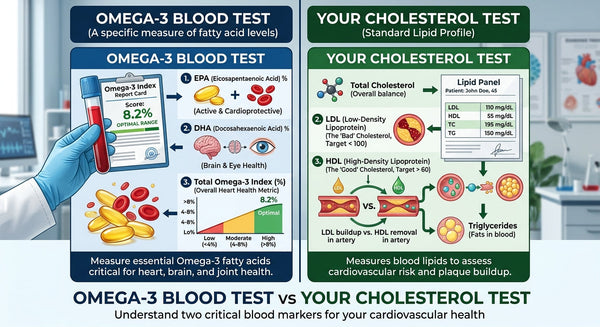
A standard lipid panel does not report EPA or DHA in cell membranes. The Omega-3 Index does — see our blood test vs cholesterol guide.
Sources
- Macartney MJ, Anthony R, Craddock J, Batterham M, Peoples GE. The Omega-3 Index and Self-Reported Dietary Intake of DHA and EPA in Highly Trained, Elite and World Class (Tier 3–5) Male and Female Athletes: An Australian Based Cross-sectional Study. Sports Medicine – Open. 2026;12:103. https://doi.org/10.1186/s40798-026-01070-5
- University of Wollongong. Could increasing omega-3 intake boost recovery and long-term health in elite athletes? Media release, 23 July 2026. https://www.uow.edu.au/media/2026/could-increasing-omega-3-intake-boost-recovery-and-long-term-health-in-elite-athletes.php
- Heart Foundation (Australia). Fish and omega-3: healthy eating advice for adults.
- Australian Institute of Sport. AIS Supplement Framework (omega-3 / EPA+DHA category).
Know your number.
A simple at-home finger-prick test, posted to your door. Find out where you actually stand on omega-3.
See our tests