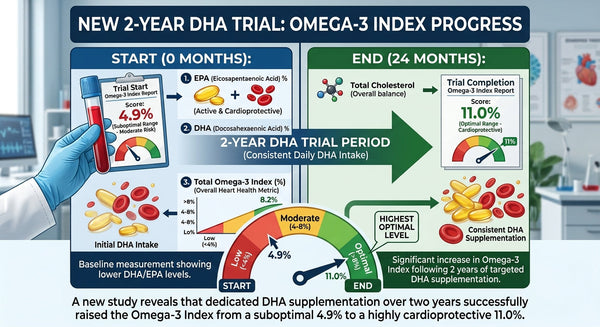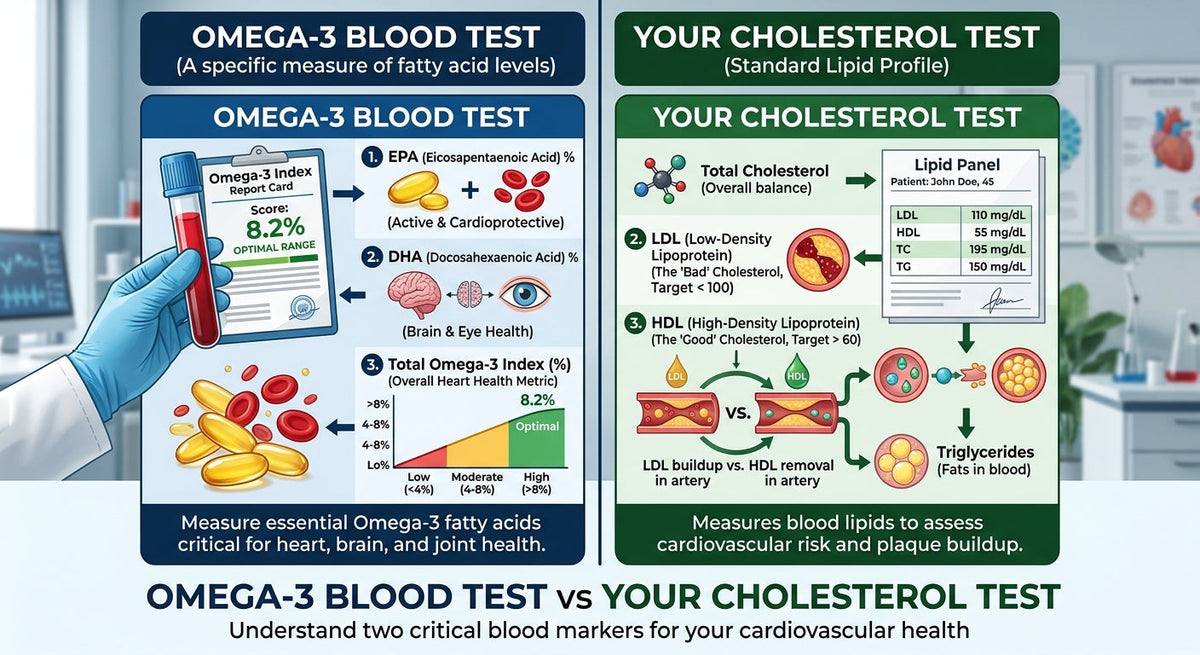
Most Australians who take fish oil have no idea whether it's working. Your GP's routine bloods won't tell you, because a standard lipid panel measures cholesterol and triglycerides, not omega-3. An omega-3 blood test does something different: it measures how much EPA and DHA has actually made it into your cells.
What an omega-3 blood test actually measures
The most widely used measure is the Omega-3 Index: EPA plus DHA as a percentage of the fatty acids in your red blood cell membranes. Because red blood cells live for around 120 days, the result reflects your intake over the past three to four months, not what you ate yesterday.
The index was proposed by Harris and von Schacky in 2004 and is now used in hundreds of published studies. Results are usually read against these bands:
| Omega-3 Index | Band |
|---|---|
| Below 4% | Low |
| 4–8% | Intermediate |
| 8–12% | Optimal (target range) |
Broader panels add the omega-6 to omega-3 ratio, the AA:EPA ratio and a full profile of 20+ individual fatty acids, including trans fats.
Why a cholesterol test doesn't tell you this
A lipid panel reports fats circulating in your blood plasma at one moment. It doesn't tell you the make-up of your cell membranes, and two people with identical cholesterol results can have very different omega-3 status. That's why the Omega-3 Index isn't part of routine Australian pathology and isn't rebated by Medicare (more in our Medicare guide).
How much omega-3 do Australians need?
The NHMRC Nutrient Reference Values set an Adequate Intake for long-chain omega-3s (DHA + EPA + DPA) of 160 mg a day for men and 90 mg for women, and a higher Suggested Dietary Target, aimed at reducing chronic disease risk, of 610 mg (men) and 430 mg (women). The Heart Foundation suggests most adults aim for 250–500 mg of EPA + DHA a day, roughly two to three serves of oily fish a week.
The catch: the same intake produces very different blood levels in different people. Body weight, genetics, the form of supplement and whether you take it with food all matter. A blood test closes that gap, and our EPA + DHA calculator turns your result into a personalised daily dose.
At-home finger-prick or a clinic blood draw?
You can now test at home with a finger-prick dried blood spot. The finger-prick is only the collection method: the card is posted to a laboratory and analysed by gas chromatography (GC-FID), the reference method for fatty-acid analysis. Published validation shows dried blood spot results correlate closely with the red-blood-cell method (R² > 0.96). We explain what to look for in are at-home omega-3 tests accurate?
Choosing between providers? Our buyer's guide to the best omega-3 test in Australia covers method, accreditation and turnaround in detail.
Faster results
Some omega-3 kits sold in Australia report results one to two weeks after the lab receives the sample. Our Omega-3 Index Basic ($89.95, free shipping both ways) is analysed by an accredited laboratory with results in 3–5 business days. For pricing and Medicare details, see is the Omega-3 Index test covered by Medicare?
What to do with your result
- Below 8%: most people need more EPA + DHA from oily fish or a supplement. Use the calculator, change one thing, and retest in about three months.
- 8–12%: keep doing what you're doing; retest yearly or after a diet change.
- Above 12%: discuss your intake with your GP or dietitian.
An omega-3 test measures nutritional status. It doesn't diagnose or treat any condition, so discuss results with your healthcare professional, especially if you take blood-thinning medication.
FAQ
Can my GP order an Omega-3 Index test? It isn't on the standard Medicare pathology schedule, so most people use a private test. You don't need a referral for an at-home kit.
Do I need to fast? No. The Omega-3 Index reflects months of intake, so a single meal doesn't change it meaningfully.
How often should I test? Every three months while you're adjusting your intake, then once a year.
Is a finger-prick test accurate enough? When the dried blood spot is analysed by GC-FID in an accredited lab, results track the red-blood-cell method closely (R² > 0.96).
Does the test check omega-6 too? Index Basic reports the Omega-3 Index. Plus Ratios and Complete add omega-6 measures.
Sources
- NHMRC/NZ MoH, Nutrient Reference Values for Australia and New Zealand: Fats (eatforhealth.gov.au)
- Heart Foundation, Fish, fish oils, omega-3 and heart health position statement (heartfoundation.org.au)
- Harris WS, von Schacky C. The Omega-3 Index: a new risk factor for death from coronary heart disease? Prev Med 2004;39:212–20
- TGA, ARTG entry 526367
Know your number.
A simple at-home finger-prick test, posted to your door. Find out where you actually stand on omega-3.
See our tests