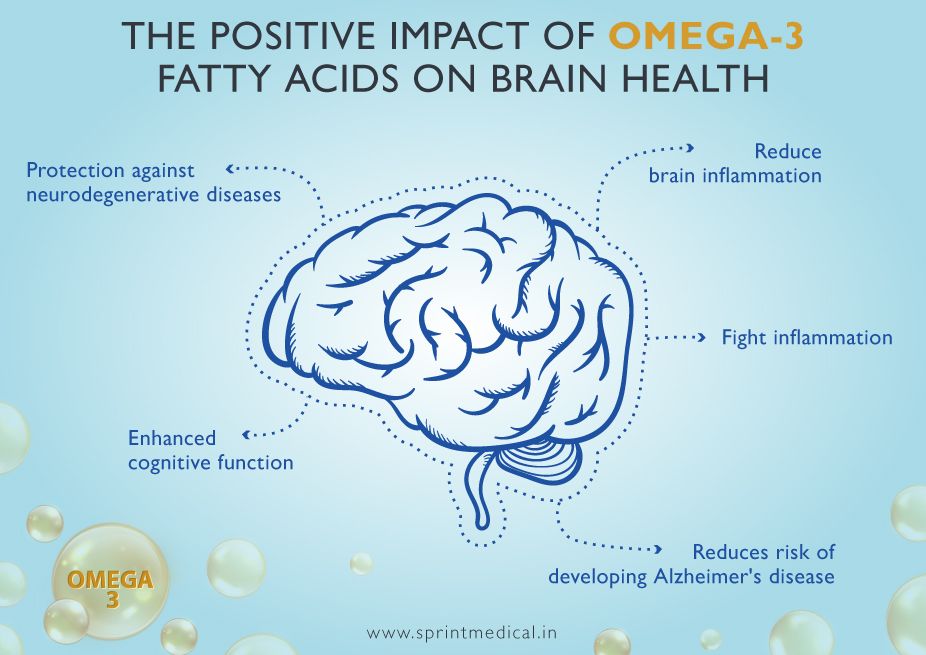
Your brain is roughly 60% fat, and a large share of that is DHA — one of the two marine omega-3s. That structural fact is why omega-3s are studied so heavily in relation to mood, memory and brain ageing. Here's an honest summary of what's solid, what's promising, and what's still uncertain.
DHA is built into the brain
DHA is the most abundant omega-3 in the brain and is concentrated in the membranes of nerve cells, where it supports the fluidity and signalling that neurons depend on. It accumulates fastest during pregnancy and early life, but the brain continues to rely on a steady supply throughout adulthood. This structural role is the least controversial part of the omega-3 and brain story.
Because the body makes very little DHA on its own — and converts very little from plant-based ALA (in flax, chia and walnuts) — most of your brain's DHA ultimately traces back to diet or supplements. That's also why your blood level can quietly drift low without any obvious signal.
Early life: the brain's biggest demand
The single period of greatest DHA demand is pregnancy and infancy, when the brain and eyes are forming rapidly. This is the area where Australian research genuinely leads the world — the SAHMRI Test-and-Treat program and the ORIP trial built a measure-first approach to omega-3 in pregnancy. If you're pregnant or planning, that's the place to start.
Mood
Research has examined omega-3s — particularly EPA-dominant formulations — in relation to mood. Some studies and meta-analyses report associations between higher EPA intake and improved mood measures, though results vary with dose, formulation and the population studied. The evidence is more mixed than for heart triglycerides, and omega-3s are not a treatment for any mental-health condition.
Memory and healthy ageing
In large observational datasets, a higher Omega-3 Index has been associated with healthier markers of brain ageing — including measures of cognition and, in some studies, larger brain volume. Because these are observational, they show association rather than proof of cause. But the consistency across independent populations, combined with the known structural role of DHA, is why the Index is increasingly tracked as people age.
EPA vs DHA for the brain
The two main marine omega-3s aren't interchangeable. DHA is the structural one, woven into neuronal membranes; EPA is more associated with signalling and the inflammatory side. Most research uses both. If you're choosing a supplement, the combined EPA + DHA dose matters more than chasing one in isolation — see EPA vs DHA: what's the difference?
Practical steps
- Know your baseline. You can't feel your omega-3 status — measure it.
- Prioritise DHA-rich sources — oily fish, or an algae/fish oil supplying both EPA and DHA.
- Be patient and retest. Levels take 8–12 weeks to reflect a change.
- Treat it as one piece of brain health alongside sleep, exercise, and managing blood pressure and glucose.
Where your Omega-3 Index fits
You can't feel your omega-3 status, and you can't get it from a standard GP blood panel. The Omega-3 Index gives you a concrete, trackable number — and most Australians sit in the low band (see where Australia sits on the global map). Knowing it lets you make an informed decision instead of guessing whether your fish-oil habit is doing anything.
See where you stand
Measure your EPA + DHA from one finger-prick. The Complete test adds your full fatty-acid profile.
Order Complete — $109.95 →References
- Dyall SC. Long-chain omega-3 fatty acids and the brain: a review of the independent and shared effects of EPA, DPA and DHA. Frontiers in Aging Neuroscience. 2015;7:52.
- Pottala JV et al. Higher RBC EPA + DHA corresponds with larger total brain and hippocampal volumes. Neurology. 2014;82(5):435-442.
- Stark KD et al. Global survey of the omega-3 fatty acids in healthy adults. Progress in Lipid Research. 2016;63:132-152.
This article is general information, not medical advice, and does not diagnose, treat or prevent any condition. If you have concerns about your mood or memory, speak with your GP.
Know your number.
A simple at-home finger-prick test, posted to your door. Find out where you actually stand on omega-3.
See our tests