Essential fatty acids are the fats your body can't make on its own — the omega-3s and omega-6s you have to get from food. An essential fatty acids test measures how much of each you actually carry in your blood, so you can stop guessing whether your diet and supplements are working. Here's what an EFA test measures, why it matters, and how to get an accurate one in Australia.
What are essential fatty acids?
There are two families of essential fatty acids (EFAs), and "essential" has a precise meaning: your body cannot synthesise them, so they must come from your diet.
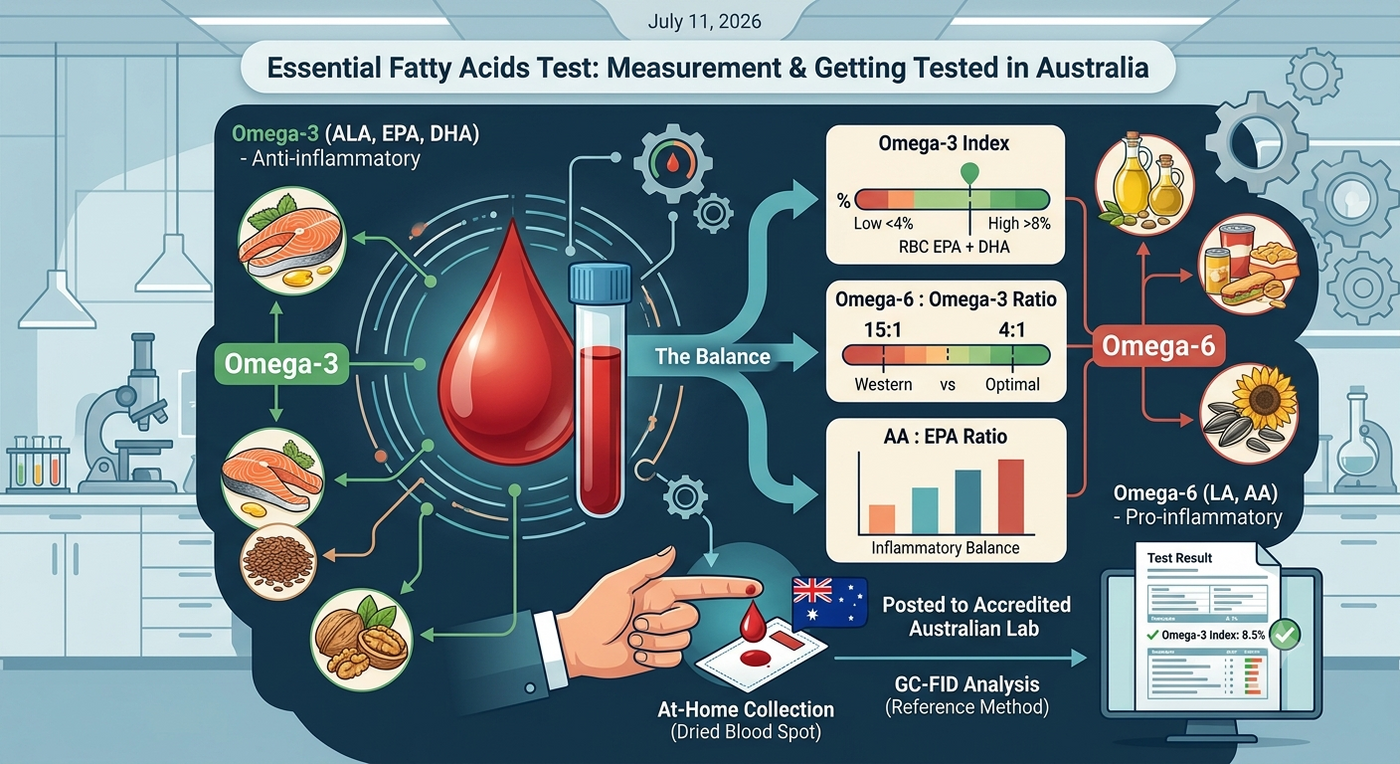
- Omega-3s — ALA (from plants like flax and chia), and the two long-chain marine forms that matter most for health, EPA and DHA.
- Omega-6s — mainly linoleic acid (LA), abundant in seed and vegetable oils, and arachidonic acid (AA), which your body makes from LA.
The two families compete for the same enzymes and push in roughly opposite directions — omega-6 derivatives tend to be more pro-inflammatory, omega-3 derivatives more resolving. So it isn't just how much of each you have; it's the balance between them that a good EFA test captures.
What an essential fatty acids test measures
A proper essential fatty acids test does more than a single number. Depending on the panel, it reports:
- Your Omega-3 Index — EPA + DHA as a percentage of your red blood cell fatty acids, on the 8–12% optimal scale used across published research.
- The omega-6 : omega-3 ratio — a marker of your overall dietary fat balance. Typical Western diets sit near 15:1; research discusses 4:1 or lower as more favourable.
- The AA : EPA ratio — a sharper, more responsive readout of inflammatory balance.
- Individual fatty acids — a full profile can quantify 24 individual fatty acids across the omega-3, omega-6, saturated, monounsaturated and trans-fat families, plus a Trans Fat Index.
The two families at a glance
| Family | Key fatty acids | Main dietary sources |
|---|---|---|
| Omega-3 | ALA, EPA, DHA | Oily fish, algae, flax, chia, walnuts |
| Omega-6 | Linoleic acid (LA), arachidonic acid (AA) | Seed & vegetable oils, processed foods, grain-fed meat |
Why test your essential fatty acids?
You can't feel your EFA status, and you can't get it from a standard GP blood panel — routine Australian pathology measures cholesterol, glucose and iron, but not EPA + DHA as a percentage of your cell membranes. Two people eating "the same" diet or taking "the same" supplement can end up with very different blood levels, because absorption, dose, consistency and genetics all vary. The only way to know where you actually stand is to measure it — and red blood cell levels reflect the previous 3–4 months, so the result is a stable picture, not a snapshot of yesterday's meal.
Testing first also lets you supplement intelligently: if you're already in the optimal range, adding more may do little; if you're low — as most Australians are — you'll know exactly how much to change. (See our guide on how much omega-3 you need daily.)
The method that actually matters
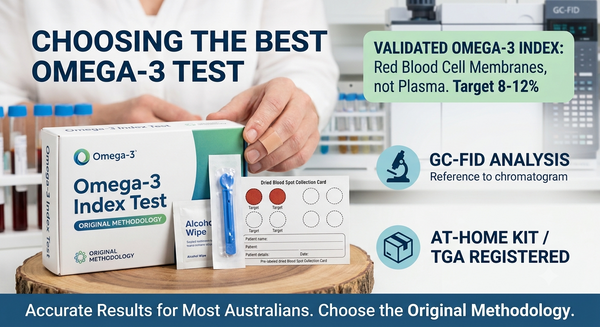
Not all fatty acid testing is equal. The reference method is gas chromatography with flame ionisation detection (GC-FID) — it physically separates and quantifies each fatty acid individually, and it's the method used in the published research that defines the Omega-3 Index. Cheaper approaches exist; if a test doesn't specify GC-FID and an accredited lab, treat the numbers with caution. (More on this in our honest answer on at-home omega-3 test accuracy.)
At-home vs pathology-lab EFA testing
An essential fatty acids test isn't something you read at your kitchen table — the analysis always happens in a laboratory. The only difference with an at-home kit is where the sample is collected: a finger-prick onto a dried blood spot card, posted back, instead of a venous draw at a clinic. For fatty acids, the dried blood spot method correlates with the gold-standard red blood cell measurement at R² greater than 0.96 when both are analysed by GC-FID — so you lose nothing in accuracy, and you skip the clinic visit, the fasting and the referral.
How to get an essential fatty acids test in Australia
We offer three levels of essential fatty acids testing, all from the same finger-prick kit, all analysed by GC-FID at an accredited Australian lab, with results in 3–5 days:
- Omega-3 Complete — the full essential fatty acids test: 24 individual fatty acids, both ratios, the Trans Fat Index, and your Omega-3 Index. Best if you want the whole picture or are working with a practitioner.
- Omega-3 Plus Ratios — your Omega-3 Index plus the omega-6 : omega-3 and AA : EPA ratios. The sweet spot for understanding your inflammatory balance.
- Omega-3 Index Basic — just the essential omega-3 number if that's all you need.
Not sure which fits? Take the 30-second quiz or read the science behind each marker.
Get your full essential fatty acids profile
Omega-3 Complete measures 24 fatty acids, both ratios and your Omega-3 Index from one finger-prick. Posted to your door, results in 3–5 days.
Order Omega-3 Complete — $109.95 →References
- Harris WS, von Schacky C. The Omega-3 Index: a new risk factor for death from coronary heart disease? Preventive Medicine. 2004;39(1):212–220.
- Stark KD, et al. Global survey of the omega-3 fatty acids in healthy adults. Progress in Lipid Research. 2016;63:132–152.
- Simopoulos AP. The importance of the ratio of omega-6/omega-3 essential fatty acids. Biomedicine & Pharmacotherapy. 2002;56(8):365–379.
This article is general information, not medical advice, and does not diagnose, treat or prevent any condition. Discuss dietary or supplement changes with your GP.
Know your number.
A simple at-home finger-prick test, posted to your door. Find out where you actually stand on omega-3.
See our tests