Your Omega-3 Index tells you how much EPA and DHA you have. The omega-6 to omega-3 ratio tells you something different and complementary: the balance between the two families of fats that compete inside your body. Here's what it means, why modern Australian diets skew it, and how the AA:EPA ratio fits in.
What the ratio actually is
Omega-6 and omega-3 are both essential fats — you need both. The catch is that they compete for the same enzymes and pathways, and the products your body makes from each tend to pull in opposite directions: omega-6 derivatives are more often pro-inflammatory, omega-3 derivatives more often resolving. The omega-6 : omega-3 ratio captures that balance in a single number.
Why modern diets skew it
Omega-6 (mostly linoleic acid) is abundant in vegetable and seed oils, which are everywhere in processed and takeaway food. Omega-3 from oily fish is comparatively scarce in the average Australian diet. The result is a ratio that has shifted dramatically over the last century.
- Typical Western diet: estimated around 15:1 or higher
- Traditional diets (and the range discussed in research as more favourable): closer to 4:1 or lower
Where omega-6 hides
You don't have to be eating badly to sit high. Omega-6 is built into the staples of a modern diet:
- Sunflower, safflower, soybean, corn and generic "vegetable oil"
- Most fried takeaway, crackers, chips and packaged snacks
- Many salad dressings, mayonnaise and margarines
- Grain-fed meat, in smaller amounts
None of these are "bad" in isolation — but together they push omega-6 up while omega-3 stays low, and the ratio drifts.
The AA:EPA ratio — a sharper inflammatory readout
The AA:EPA ratio zooms in on the two fatty acids most directly tied to inflammatory signalling: arachidonic acid (AA, an omega-6 used to make pro-inflammatory molecules) versus EPA (an omega-3 that feeds the resolving side). Because EPA responds quickly to dietary change, the AA:EPA ratio is one of the most responsive markers you can move — and a practical readout of your inflammatory tone.
What's a "good" ratio?
There's no single universally agreed cut-off, and the research uses different thresholds. What's consistent is the direction: lower is generally considered more favourable for inflammatory balance, and you lower it primarily by raising EPA and DHA. The exact numbers matter less than the trend in your own results over time.
Three practical ways to rebalance
- Add omega-3, don't just cut omega-6. Two to three serves of oily fish a week, or a supplement, is the most reliable lever.
- Swap cooking oils toward olive oil, and lean on whole foods over packaged ones.
- Measure, then re-measure. The ratio is responsive — retesting after 8–12 weeks shows whether your changes are working.
How to measure your ratios
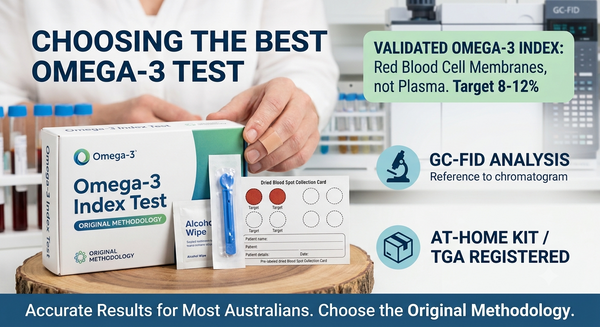
The standard Omega-3 Index on its own doesn't give you these ratios. Our Plus Ratios test adds the omega-6 : omega-3 and AA : EPA ratios (plus a Trans Fat Index), and Complete reports your full 24-fatty-acid profile. Both use the same finger-prick. For the science behind every marker, see The Science.
See your ratios, not just your Index
Plus Ratios reports your omega-6:omega-3 and AA:EPA balance from a single finger-prick.
Order Plus Ratios — $99.95 →References
- Simopoulos AP. The importance of the ratio of omega-6/omega-3 essential fatty acids. Biomedicine & Pharmacotherapy. 2002;56(8):365-379.
- Simopoulos AP. An increase in the omega-6/omega-3 fatty acid ratio increases the risk for obesity. Nutrients. 2016;8(3):128.
- Stark KD et al. Global survey of the omega-3 fatty acids in healthy adults. Progress in Lipid Research. 2016;63:132-152.
This article is general information, not medical advice, and does not diagnose, treat or prevent any condition.
Know your number.
A simple at-home finger-prick test, posted to your door. Find out where you actually stand on omega-3.
See our tests